


| Name | Modified | Size | Downloads / Week |
|---|---|---|---|
| v3.0.3 | 2026-07-14 | ||
| bitResurrector_v3.0.3_Setup.exe | < 16 hours ago | 46.4 MB | |
| seedrecoverytool.png | 2026-09-17 | 109.7 kB | |
| README.md | 2026-09-15 | 22.7 kB | |
| WHITE_PAPER.txt | 2026-09-14 | 20.2 kB | |
| BitresurrectorReview.gif | 2026-08-22 | 6.9 MB | |
| interface.png | 2026-02-02 | 166.9 kB | |
| interface-proof.png | 2026-02-02 | 237.2 kB | |
| bitResurrector_logo.png | 2026-02-02 | 1.7 MB | |
| bitResurrector_logo.jpg | 2026-02-02 | 182.6 kB | |
| Totals: 10 Items | 55.7 MB | 37 |
 BitResurrector v3.0.3 — Open-Source Bitcoin Key & Seed Phrase Recovery Ecosystem


BitResurrector is an advanced, multi-threaded Bitcoin asset recovery workstation designed to search for lost or dormant Bitcoin wallets, reconstruct physically damaged 12-word mnemonic phrases, and verify addresses with positive on-chain balances. Combining autonomous Private Key Scanning (secp256k1) with an integrated Seed Phrase Recovery & Gap Limit Inspection subsystem, BitResurrector delivers maximum mathematical efficiency and throughput on standard PC hardware.
🔴 LIVE PROOF OF WORK:

👉 ▶️ CLICK HERE TO WATCH FULL UNCUT HD PROOF VIDEO
🧭 System Capabilities Overview
BitResurrector operates two specialized recovery engines designed for digital asset discovery:
| Engine | Primary Purpose | Cryptographic Standard | Search Methodology |
|---|---|---|---|
| Autonomous Private Key Hunter | Continuous background scanning for forgotten & dormant Bitcoin wallets | secp256k1, WIF (Compressed / Uncompressed) | 9-Echelon Entropy Filter + 256MB Bloom Filter ($O(1)$) + CUDA Acceleration |
| Seed Recovery & Gap Limit Inspection | Targeted reconstruction of damaged 12-word mnemonic phrases (6 to 11 known words) | BIP-39, BIP-44, BIP-49, BIP-84, BIP-86, Electrum Seed | 12-Slot Positional Grid + Extended Gap Limit ($40..100$) + Dynamic Scoring API Matrix |
⚖️ Industry Benchmark & Competitive Matrix
Unlike single-threaded console scripts or commercial recovery services charging 20% to 30% contingency fees, BitResurrector v3.0.3 delivers a fully integrated, zero-trust autonomous desktop workstation.
| Functional Capability | Standard CLI Scripts (e.g. btcrecover) | Commercial Recovery Services | BitResurrector v3.0.3 Ecosystem |
|---|---|---|---|
| User Interface & Workflow | Headless CLI, JSON arguments, terminal | Custodial third-party (requires NDA/trust) | Interactive 12-Slot Visual GUI + Bidirectional Bar |
| Mnemonic Permutation (12! Words) | Sequential brute-force (impractical runtime) | Multi-day private cluster queuing | Hardware SHA-256 Checksum Pruning (29.9M in 1–2 hrs) |
| Circular Ring / Capsule Rotations | Manual script modification required | Manual testing | Automated 12-Cycle Evaluation in < 0.002 seconds |
| Hybrid Jigsaw Recovery | Unsupported (requires exact index positions) | Custom manual scripting | Native: Locked Slots + Unordered Pool (ADDITIONAL) |
| SatoshiLabs Typo Clustering | Basic wordlist check / simple edit distance | Manual phonetic guessing | 271-Cluster Confusion DB + Levenshtein Engine |
| 1-Click Slot Constraining | Not available (2048 words scanned per slot) | None | Alpha + Length Matrix (shrinks slot space to 8–12 words) |
| Balance Detection Subsystem | Full Bitcoin Core node or remote API spam | Private archival indexers | Embedded 256MB RAM Bloom Filter ($O(1)$ lookup) |
| Derivation Standard Breadth | Usually single-path (manual BIP flag) | Variable | Multi-standard (BIP-44, 49, 84, 86, Electrum v1 & v2) |
| Deep Gap Limit Inspection | Standard default gap limit (20 addresses) | Custom manual depth | Autonomous Extended Gap Limit ($40..100$ addresses) |
| Entropy Firewall & CVE Hunter | None (wastes GPU cycles on defective entropy) | Rare proprietary heuristics | 5 CSPRNG Statistical Barriers + 6 CVE Anomaly Engines |
| GPU Acceleration Architecture | Generic unoptimized OpenCL loops | Private hardware clusters | Auto-Calibrated Compute Units + Persistent VRAM Pooling |
| Privacy & Custody Model | Local execution, complex dependencies | Third-party custody risk (20–30% fee) | 100% Offline Air-Gap Capable, Zero Outbound Telemetry |
🛡️ Advanced CSPRNG Entropy Filters & Statistical Barriers
The Seed Phrase Recovery and Key Hunting engines incorporate an ultra-low-latency statistical firewall that verifies the mathematical properties of raw candidate entropy before executing heavy PBKDF2 HMAC-SHA512 iterations or secp256k1 scalar multiplications:
- Monobit Bit-Density (Hamming Weight): Evaluates bit balance across the 128-bit BIP-39 entropy vector. Following a Gaussian distribution ($\mu=64, \sigma=5.66$), the default filter ($45 \le W \le 83$) enforces a $\pm 3.35\sigma$ corridor, preserving 99.98% of authentic hardware wallets while rejecting anomalous PRNG noise.
- Bit Run Limit Barrier: Blocks candidates exhibiting $> 16$ consecutive identical bits, filtering out hardware sensor stuck-at faults and uninitialized register loops.
- Word Index Variance Barrier ($\sigma \ge 180$): Rejects degenerate human-assembled phrases clustered within unnaturally narrow alphabetical dictionary windows.
- Irwin-Hall Word Sum Barrier ($7,000 \le \sum \le 17,500$): In authentic 12-word mnemonics, the sum of dictionary indices ($0..2047$) strictly follows a 12-fold Irwin-Hall distribution centered at $12,282$. Phrases outside this corridor are mathematically inconsistent with genuine wallet entropy.
- Electrum v1 Polynomial Overlap Barrier ($\pmod{1626}$): Prunes 16.5% of 32-bit scalar overflow combinations prior to executing 100,000 legacy SHA-256 derivation rounds.
⚠️ Active CVE Flawed Entropy Generator & Anomaly Detector
Waiting for historical RNG flaws to appear by pure chance during standard generation is statistically unviable ($P < 10^{-9}$). When CVE Mode is activated, BitResurrector inverts statistical validation windows and actively synthesizes defective mnemonics matching documented historical vulnerabilities:
- CVE-2013-7372 (Android Java SecureRandom Bug): Reconstructs legacy mobile wallets created prior to 2014, where 128-bit entropy collapsed into a 32-bit internal state or truncated PID/timestamp seed ($2^{32}$ keyspace instead of $2^{128}$).
- Stuck Bytes & Uninitialized Memory: Emulates hardware sensor freezes, buffer underflows, or RAM leaks where 4 to 10 consecutive bytes lock at
0x00,0xFF, or static hardware register patterns. - Extreme Monobit Skew (15..35 & 90..115): Targets severe bit density asymmetries caused by defective analog noise generators in vintage hardware tokens.
- Long Bit Runs (16..32 bits): Exploits frozen shift registers or stuck entropy gates in embedded microcontrollers.
- Vocabulary Modulo Bias (Modulo 256 / 512): Targets early broken third-party scripts where developers mapped entropy bytes to words using modulo arithmetic (
byte % 256orval % 512) instead of 11-bit windows, trapping all 12 words within the first 256 or 512 words of the BIP-39 dictionary. - Repeating Chunks & Firmware Loops: Reconstructs firmware RNG loops generating repeating word triplets (
w0 w1 w2 w0 w1 w2...), quad repetitions, or mirrored halves.
🧩 Real-World Seed Phrase Disaster Recovery Scenarios
The Seed Recovery Subsystem is an industrial-grade precision recovery tool engineered to restore forgotten, physically degraded, truncated, or scrambled 12-word mnemonic phrases across BIP-39, BIP-84, BIP-86 (Taproot), BIP-49, and Electrum v1/v2 standards. Below are seven representative real-world degradation patterns, their underlying mathematical complexity, and BitResurrector's algorithmic solutions.
Case 01: Torn Paper Edge — Missing Final Two Words (#11 and #12)
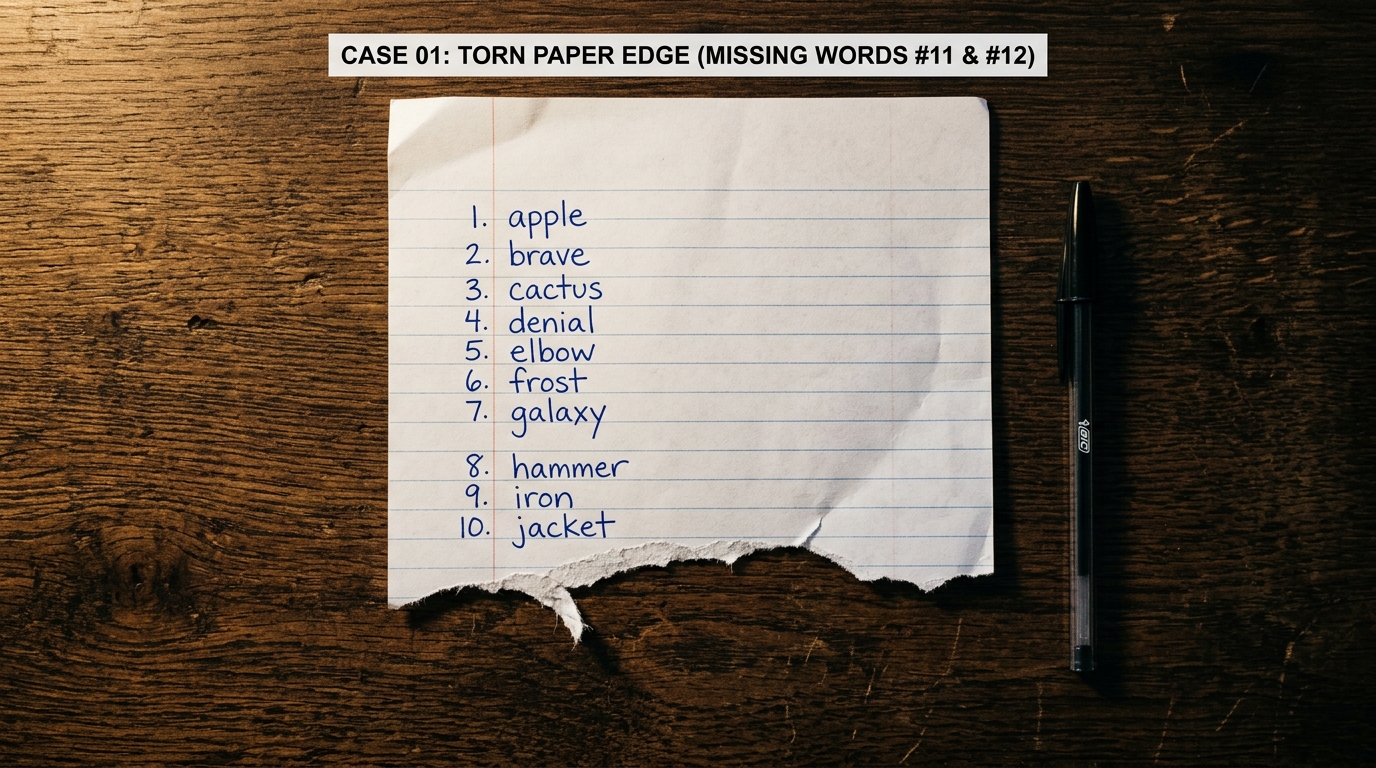
- Physical Degradation State: Mechanical tearing, edge abrasion, or moisture separation destroyed the bottom portion of a paper backup card. Words #1 through #10 are completely intact and clearly readable, while words #11 and #12 are missing entirely. Conventional wallet software rejects partial inputs with strict checksum syntax errors.
- Combinatorial Search Space: Testing two completely unconstrained 11-bit dictionary positions requires traversing $2048^2 = 4,194,304$ raw permutations.
- Algorithmic Resolution: The BIP-39 specification binds a 4-bit SHA-256 checksum into the final word. BitResurrector's SIMD-vectorized bitwise filter discards 93.75% ($15/16$) of all permutations before key derivation, reducing the candidate field to exactly $262,144$ mathematically valid phrases.
- Balance Identification & Throughput: Parallel multi-core CPU and CUDA SIMD pipelines derive active address formats (Native SegWit, Taproot, Nested SegWit, Legacy) and verify them against the pre-loaded 256MB in-memory Bloom filter ($> 0\text{ SAT}$). Without requiring a known target address or network connection, the funded phrase is isolated and restored in 15–20 seconds.
Case 02: Liquid & Ink Staining — Word #7 Obscured, Initial Letter & Length Known
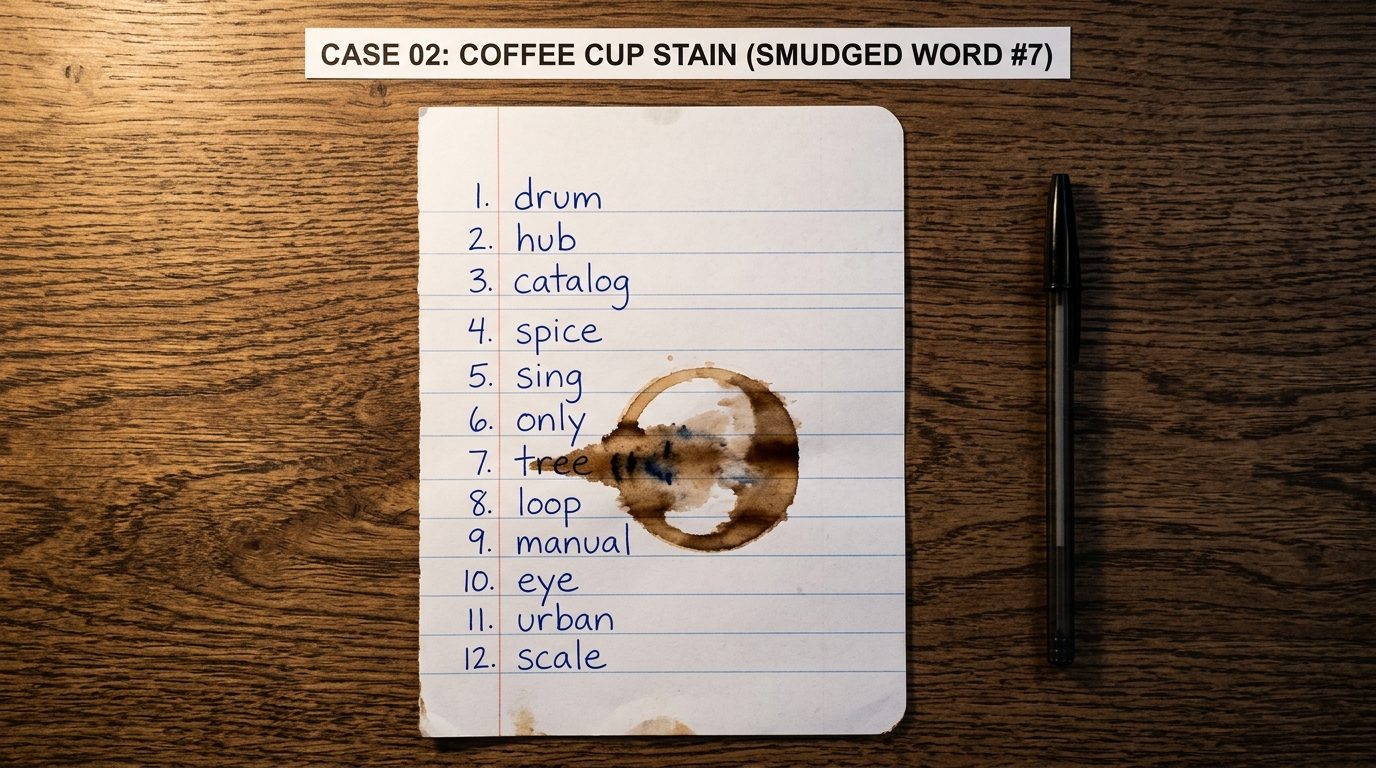
- Physical Degradation State: A spilled beverage soaked the recovery sheet, dissolving the ink across word #7 into an illegible pigment smudge. Close visual inspection reveals that the initial character is definitively
t, and the underlying card geometry confirms a 4-letter word boundary. - Combinatorial Search Space: An unconstrained single-word recovery spans the full 2,048-word BIP-39 dictionary, generating 128 valid checksum configurations across the remaining slots.
- Algorithmic Resolution: Applying positional alphanumeric and character-length boundary masks constrains the dictionary slice to words matching
^t...$. Across the entire 2,048-word lexicon, only 15 words satisfy this joint condition (talk,task,team,test,that,then,they,thin,this,tiny,tool,tour,town,trap,tree). - Balance Identification & Throughput: This parametric constraint compresses entropy by 136x. The derivation engine evaluates the 15 candidate branches and matches them against the on-chain Bloom database in under 0.05 seconds.
Case 03: Circular Metal Disc & Washer Stacks — Continuous Ring Without Start Index
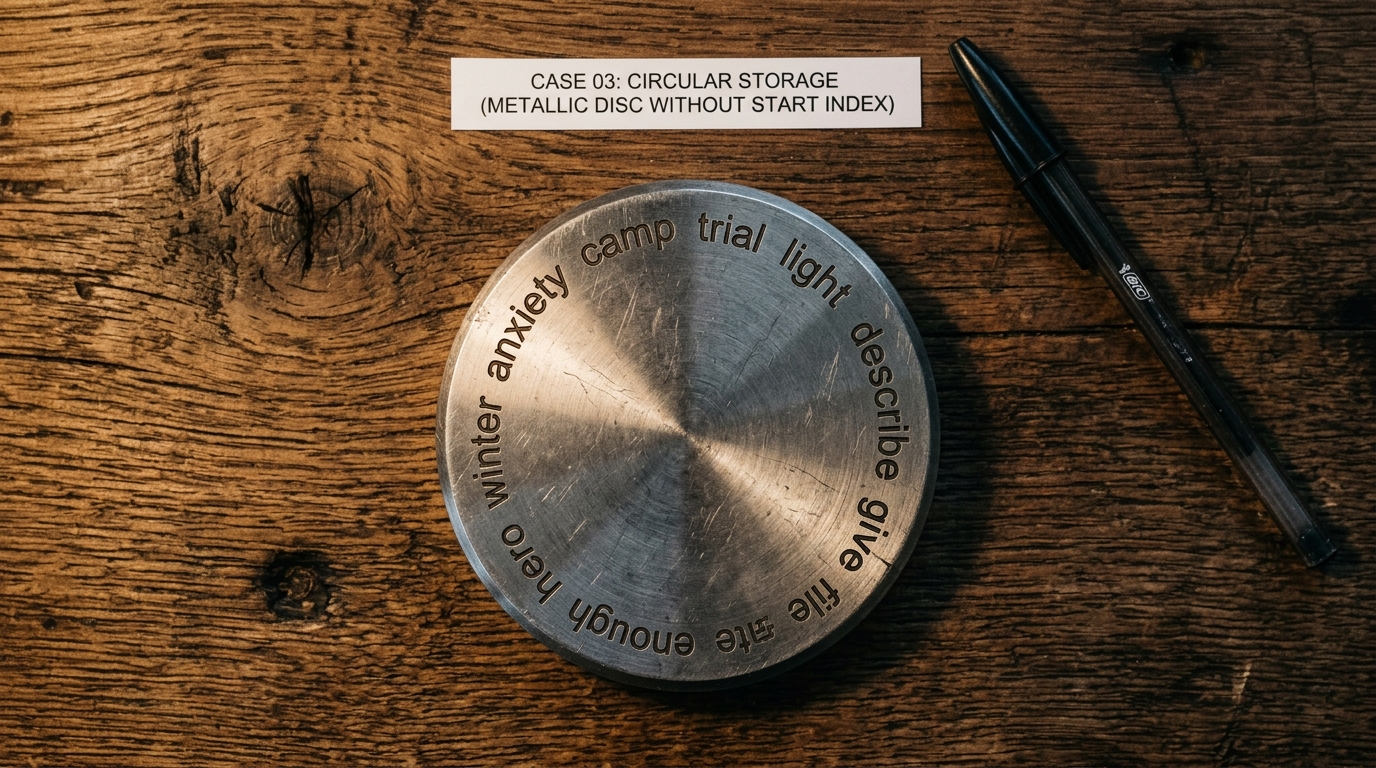
- Physical Degradation State: Twelve valid mnemonic words were stamped circumferentially around a titanium capsule, circular disc, or metal washer stack (Cryptosteel, Cobo, Keystone). Because no directional index or starting delimiter was marked, the reader possesses all 12 genuine words in clockwise sequence, but the true index of word #1 ($k \in [0..11]$) is unknown.
- Combinatorial Search Space: Exactly 12 circular cyclic permutations exist: $S_k = (w_k, w_{k+1}, \dots, w_{(k+11) \pmod{12}})$.
- Algorithmic Resolution: Because the BIP-39 4-bit checksum is calculated over the entire 128-bit concatenated sequence, shifting the starting index disrupts the bit alignment of entropy and checksum. Consequently, non-origin rotational shifts produce invalid checksum bits in 15 out of 16 cases.
- Balance Identification & Throughput: BitResurrector streams all 12 cyclic permutations through its hardware hashing pipeline in under 0.002 seconds, filtering false rotations and confirming the genuine funded wallet via in-memory Bloom verification.
Case 04: Two-Column Unnumbered Layout — Row-Major vs Column-Major Ambiguity

- Physical Degradation State: A recovery phrase was recorded in a pocket notebook across two vertical columns of six lines each, without serial numbering. The user cannot determine whether the words were written horizontally row-by-row ($L_1 \to R_1 \to L_2 \to R_2 \dots$) or vertically column-by-column ($L_1..L_6 \to R_1..R_6$), or in reverse orientation.
- Combinatorial Search Space: A $2 \times 6$ planar grid generates primary topological trajectories: horizontal row-major, vertical column-major, alternating serpentine patterns, and inverted reading directions.
- Algorithmic Resolution: The spatial transposition engine maps the 12 words across standard planar trajectory matrices. Each geometric path is immediately tested against the BIP-39 checksum requirement, rejecting incorrect traversal paths without incurring elliptic curve computation overhead.
- Balance Identification & Throughput: All structural permutations are evaluated in sub-seconds. The authentic sequence that satisfies both the cryptographic checksum and the on-chain UTXO balance threshold is isolated automatically.
Case 05: Thermal Exposure & Burn Perforations — Multi-Slot Masked Synthesis
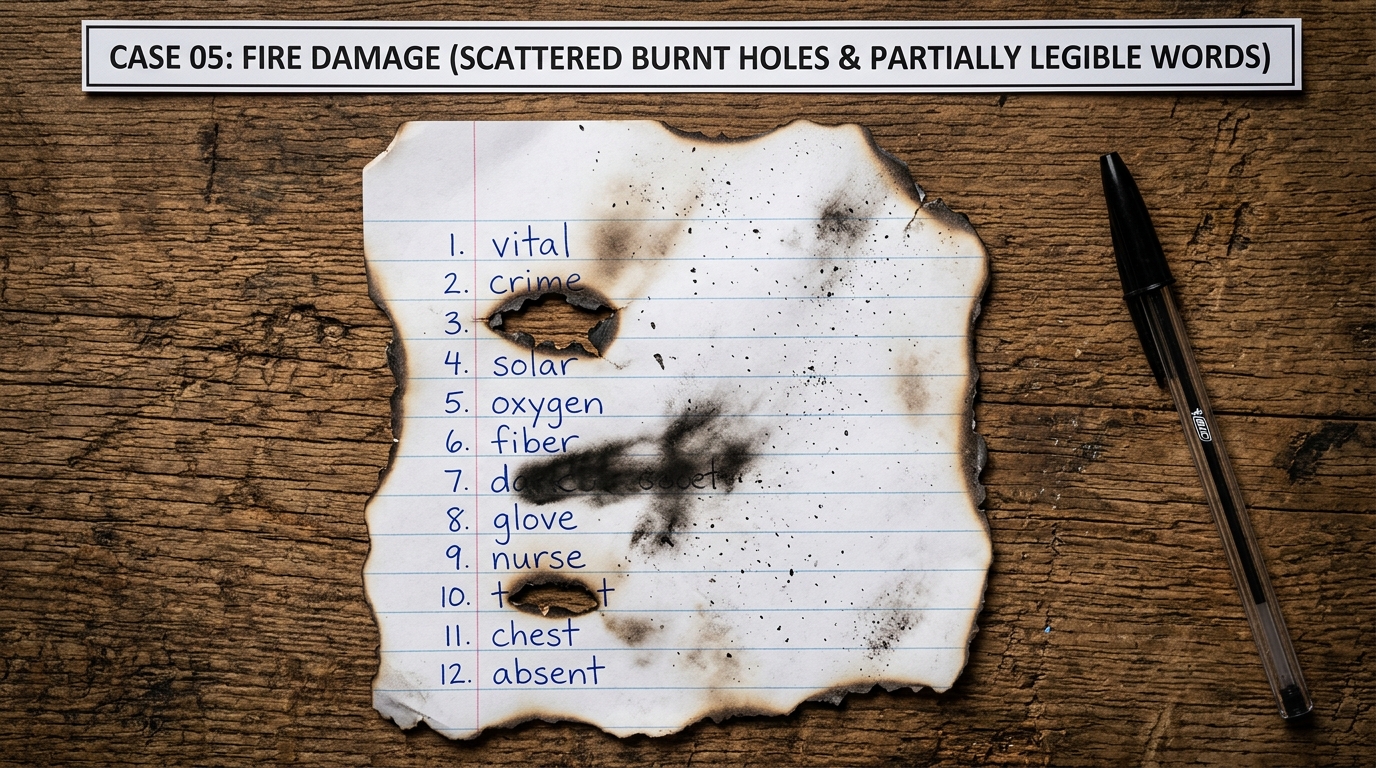
- Physical Degradation State: A paper archive survived high-temperature exposure. Thermal charring created irregular burn holes: slot #3 is completely incinerated, soot over slot #7 preserves only the leading character
dwith an approximate 6-letter boundary, and charred edges at slot #10 leave leading charactertwith a 4-letter boundary. Nine words (including word #12) remain fully legible. - Combinatorial Search Space: Blind combinatorial brute-force across three missing positions demands $2048^3 = 8,589,934,592$ iterations—computationally prohibitive on local hardware without days of distributed clustering.
- Algorithmic Resolution: BitResurrector combines positional letter-length constraints with bitwise checksum pruning. Slot #7 is constrained to 28 candidates (
^d.{5}$), slot #10 is constrained to 15 candidates (^t.{3}$), and slot #3 evaluates the dictionary against the remaining checksum constraints. This reduces the search volume from 8.58 billion down to just 23,040 mathematically viable candidate phrases (a 372,000x search space reduction). - Balance Identification & Throughput: Utilizing parallel SIMD worker pools, BitResurrector derives address vectors across BIP-84 and BIP-86 standards and validates them against the in-RAM Bloom filter in under 0.8 seconds.
Case 06: Cursive Ambiguity & Phonetic Slips — SatoshiLabs Error Clustering
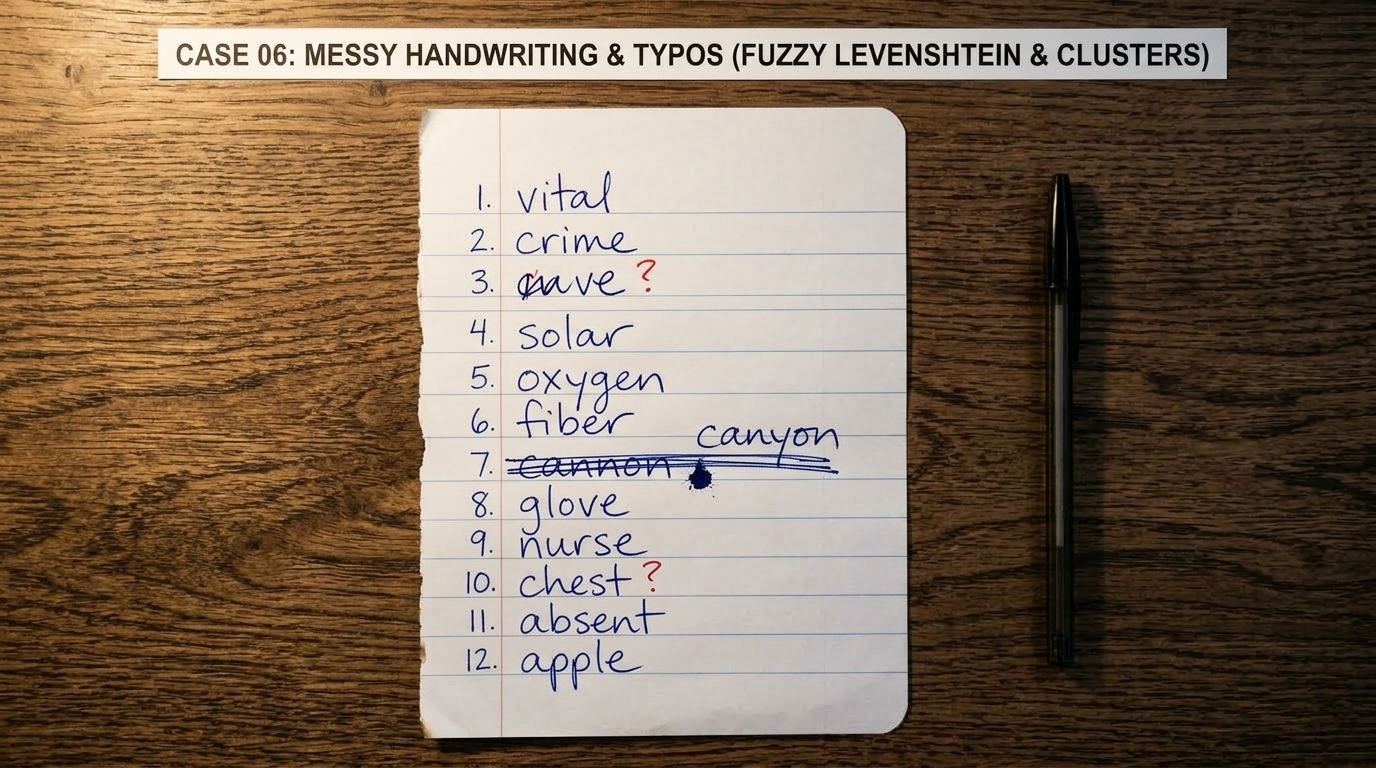
- Physical Degradation State: A hastily scribbled paper note contains multiple handwriting and spelling ambiguities: cursive loops make word #3 readable as either
caveorwave, word #7 exhibits an phonetic/orthographic substitution (cannonvscanyon), and word #10 has an ambiguous cursive tail (barevsbear). - Combinatorial Search Space: Independent combinatorial combinations of 2 to 4 visual alternatives per ambiguous slot create dozens of plausible dictionary configurations, none of which can be validated manually without repeatedly encountering wallet checksum errors.
- Algorithmic Resolution: The recovery engine integrates the complete SatoshiLabs repository of 271 homophone and optical confusion clusters (501 documented confusion pairs), combined with weighted Levenshtein distance scoring.
- Balance Identification & Throughput: The engine generates all mutation branches across the identified confusion clusters, verifies mathematical checksum validity, and tests derived public keys against funded addresses. The exact intended mnemonic is resolved and verified in fractions of a second.
Case 07: Four-Piece Cross-Fold Split & Crease Abrasion
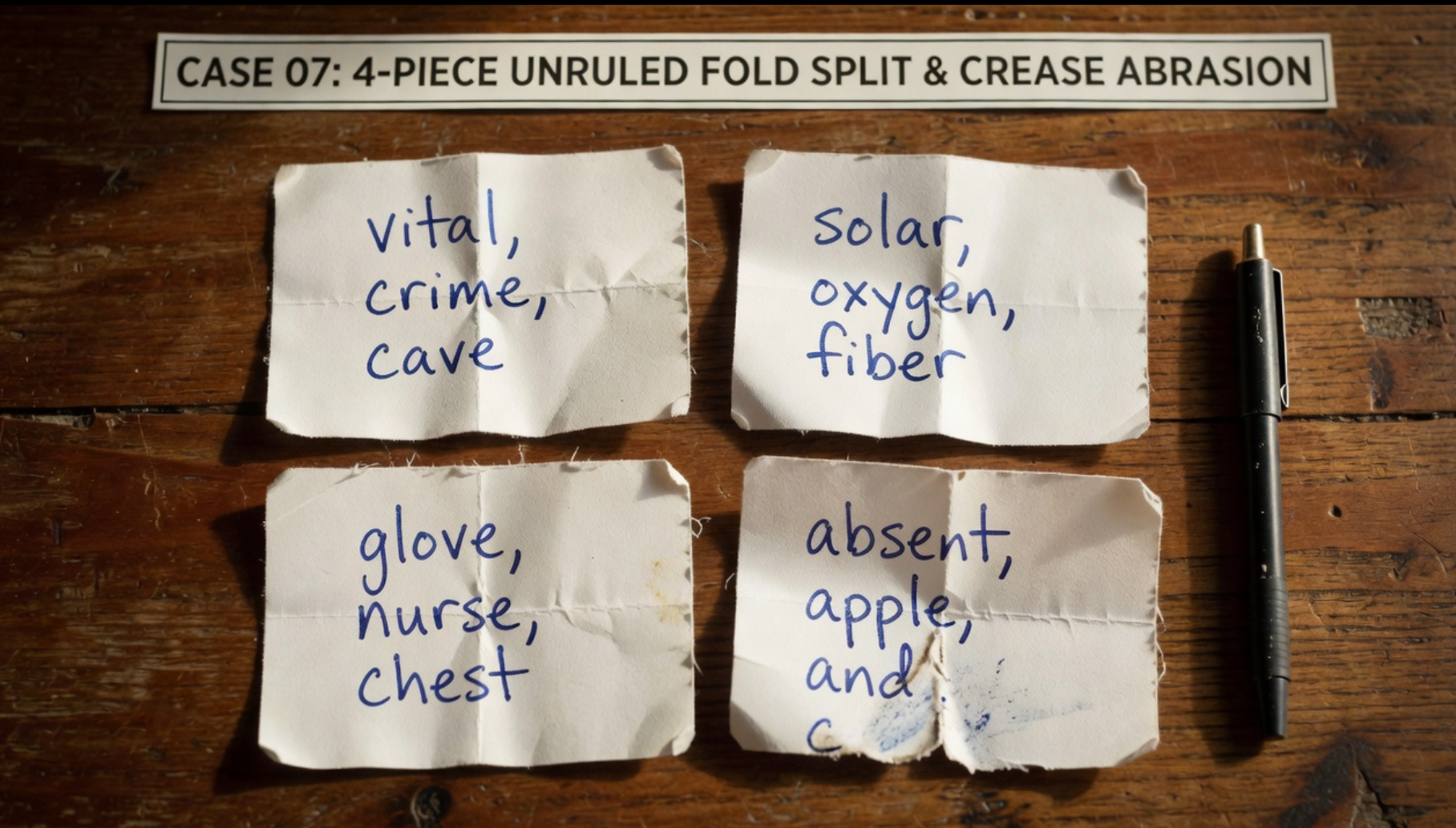
- Physical Degradation State: A 12-word seed phrase was recorded on an unruled, plain white paper sheet without numbering. Folded in four and stored under pressure for years, the paper fractured cleanly along perpendicular fold creases into four matching rectangular quadrants. Each quadrant contains three legible words, but the quadrants lack unique edge profiles. In addition, friction at the central intersection abraded the final word on quadrant #4, leaving only the initial letter
cand an approximate 6-letter length. - Combinatorial Search Space: Ordering four identical quadrants yields $4! = 24$ spatial permutations. For the damaged word, the prefix-length pattern
c.....matches a narrow subset of the BIP-39 lexicon (canyon,casual,cattle,celery,clutch). - Algorithmic Resolution: The quadrant combinatorial engine evaluates all 24 spatial block arrangements while simultaneously testing valid candidate words for the abraded slot. Each assembled 12-word sequence undergoes immediate 4-bit SHA-256 checksum verification, eliminating 93.75% of synthetic candidates before key derivation.
- Balance Identification & Throughput: Deriving multi-standard addresses across the remaining valid candidates and querying the local 256MB Bloom filter isolates the authentic funded wallet in under 0.05 seconds.
⚡ Key Engine Capabilities:
- Dual-Standard Cryptography: Full native derivation for BIP-39 (Native SegWit
bc1q..., Taprootbc1p..., Nested SegWit3..., Legacy1...), Electrum Seed v2 (Standard Legacy & Native SegWit), and vintage Electrum v1 (1626-word dictionary). - Instant Cloudflare R2 Edge Start: Zero-wait start using a pre-built 256MB Bloom Filter with automated HTTP Range resume (
.part) for instant local RAM searches. - Extended Gap Limit 40 to 100: Inspects the first 20 external receiving and 20 internal change addresses, automatically expanding depth up to 100 addresses upon finding positive balances.
- Target Address RAM Matching: When entering a known public address, the engine routes derivations strictly to the matching path, achieving millions of validations per second.
- Hardware GPU Auto-Calibration & Buffer Pooling: Automatically queries OpenCL/CUDA compute units to size batches dynamically, maintaining up to 900,000+ derived addresses per second with zero memory thrashing.
- Automatic Output Logging: Every recovered seed phrase, derivation path, balance, and timestamp is securely written to
output/seedrecovered.txt.
⚡ Autonomous Private Key Scanner & Sniper Engine
The primary background engine scans the 256-bit scalar space to locate lost early-era Bitcoin assets (2009–2015).
🛠️ 9-Echelon Intelligent Entropy Filter
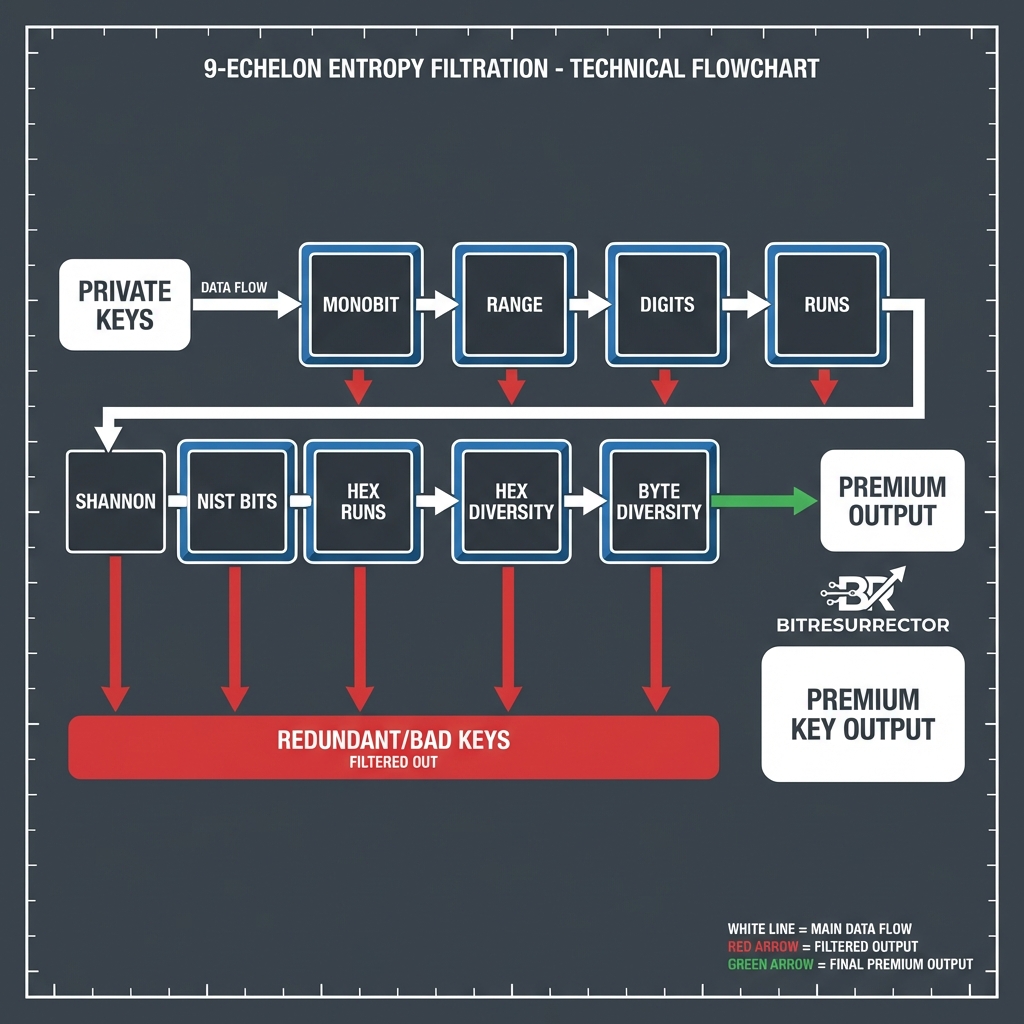
- Monobit Frequency Test (NIST SP 800-22): Evaluates Hamming Weight ($[110, 146]$ corridor).
- Numerical Gravity ($10^{76}$ Range): Targets the maximum information density sector ($10^{76} \le k < 10^{77}$).
- Decimal Alphabet Spectral Diversity: Enforces $\ge 9$ unique decimal digits.
- Runs Test (Repetition Analysis): Blocks consecutive runs of $\ge 7$ identical characters.
- Shannon Information Entropy: Enforces $H \ge 3.10$ threshold against CVE-2013-7372 entropy collapses.
- Longest Binary Run Test: Detects buffer initialization defects ($\ge 17$ identical bits).
- Hexadecimal Cyclicity Analysis: Eliminates memory padding artifacts.
- HEX Alphabet Diversity: Demands $\ge 13$ unique hex characters out of 16.
- Byte Diversity Metric (AIS 31): Requires $\ge 20$ unique bytes per 32-byte scalar.
💰 How to Withdraw Recovered Bitcoin via Electrum
When BitResurrector discovers a private key or successfully recovers a seed phrase:
- Open Electrum Wallet on your computer.
- For Seed Phrases:
- Choose Create New Wallet $\to$ Standard Wallet $\to$ I already have a seed.
- Enter the 12-word mnemonic from
output/seedrecovered.txt. - Under Options, enable BIP39 Seed if recovering a BIP-39 mnemonic.
- Electrum will scan all derived addresses and display your total balance.
- For Private Keys (WIF):
- Choose Import Bitcoin addresses or private keys.
- Paste the discovered WIF key (
5K...,L...,K...) fromoutput/found_balance_keys.txt. - Click Import and broadcast a transaction to transfer funds to your secure cold storage wallet.
🚀 Performance & System Requirements
- Operating System: Windows 10 / 11 (64-bit), Linux (via Wine/Native).
- RAM: 4 GB minimum (8 GB recommended for multi-core derivation).
- CPU: Dual-Core 2.0 GHz+ (AVX / AVX2 / SSE4.2 / BMI2 supported).
- GPU: NVIDIA CUDA (optional, enables parallel GPU acceleration).
- Database: High-speed binary 256MB Bloom Filter with zero disk I/O bottlenecks.
🌐 Official Links & Community
- Official Software Website: https://ai-seedfinder.com/bitresurrector
- Knowledge Base & Scenarios: https://bitcoinrecovery.site
- High-Performance Cloud AI Version: https://ai-seedfinder.com/prices
- Telegram Channel: @ai_seed_finder
- Official Download Mirror: Download BitResurrector Setup
© 2026 AI CryptoTeam. Developed for the Future of Bitcoin Security & Digital Asset Recovery.


