
Menu
▾
▴

Individuals
The schema of an individual in µGP is summarized by the following figure.
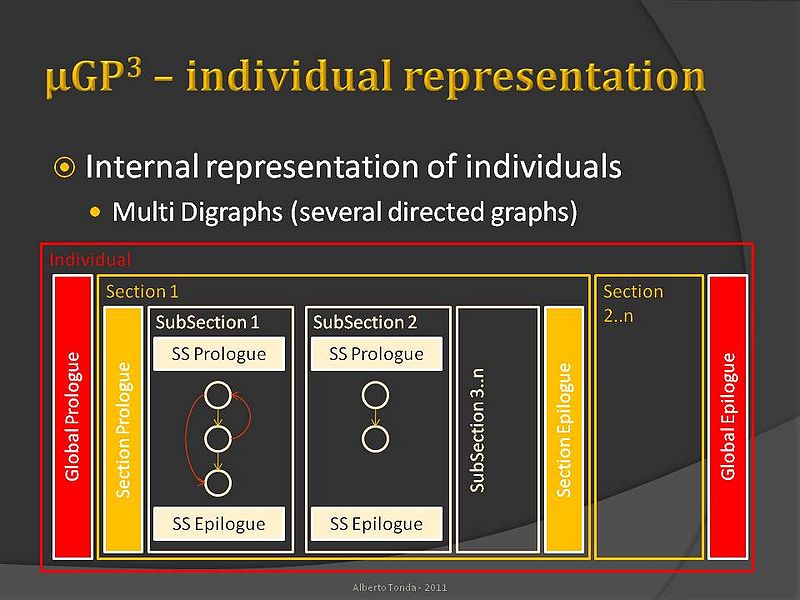
The global prologue and global epilogue are two fixed parts that will appear always at the beginning and at the end of each individual.
A section is a part that appears exactly one time, has two fixed parts that will appear at its beginning and at its end (section prologue and section epilogue) and can contain any number of subsections.
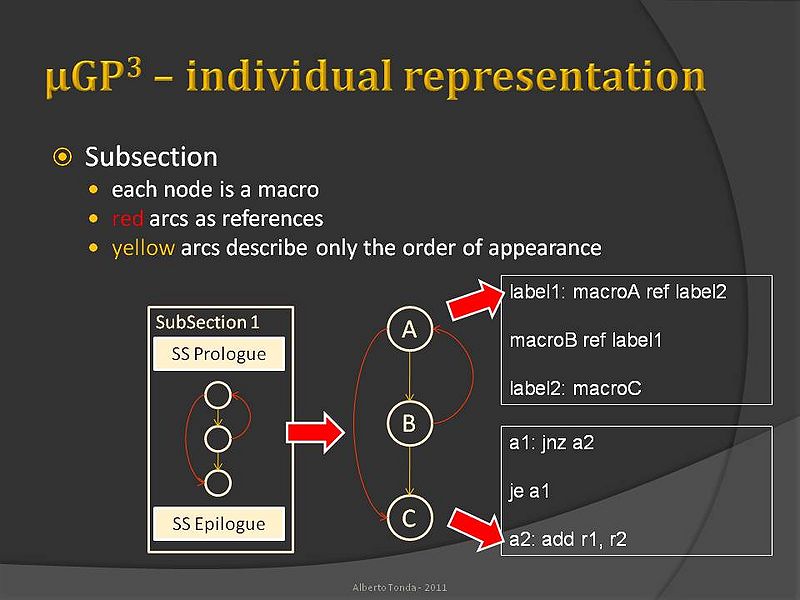
A single subsection may appear in several instances inside a certain section. If a section contains different subsections, all instances of the first subsection will appear before all instances of the second, and so on. Each subsection also has a subsection prologue and a subsection epilogue. Inside each subsection, the user can define any number of macros, that will appear in a random order.
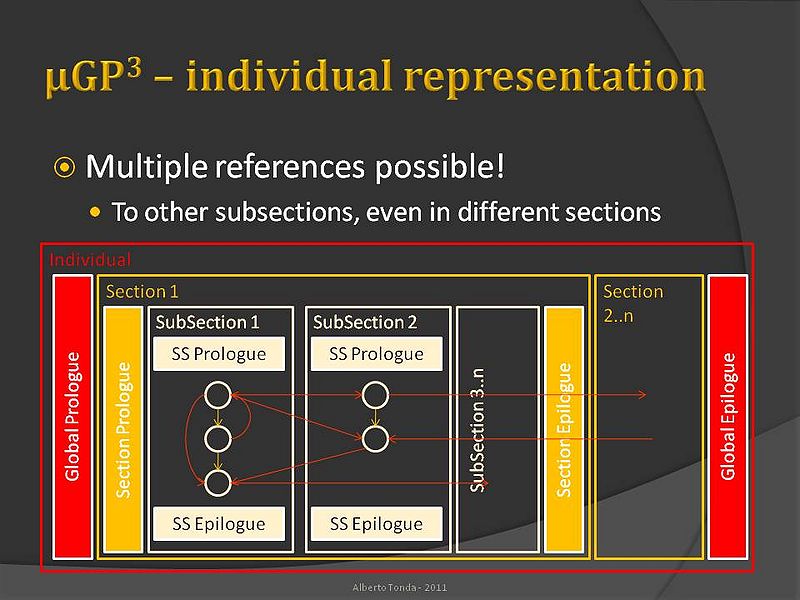
References may exist from one node to the other inside the same subsection, or from one subsection to a different one (even in different sections). For more information, see innerLabel and outerLabel parameters in the Macro page.
Constraints and Graphs
There is an important conceptual distinction between individual constraints and an actual individual, which can be seen as the same distinction between a class and an instance of the same class. Individual constraints describe how individuals are shaped: how many sections, how many subsections, how many instances for each subsection, etc. A single individual conforms to the constraints, and every element inside refers to a specific part of the constraint.
For example, an individual could have a subgraph with five nodes: nodes 1, 3 and 4 are instances of macro A described in the constraints, while node 2 is an instance of macro B and node 5 is an instance of macro C. The whole subgraph is an instance of subsection ssA.
So, in µGP's terminology, a Graph can be seen as an instance of a Section; a SubGraph can be seen as an instance of a SubSection; and a Node can be seen as an instance of a Macro.
Related

