Nysiris Wiki
Nysiris is a modular, decentralized P2P transport and portal framework
Brought to you by:
tribewarez


⚠️ Experimental / pre-audit. This repository is under active development
and has not had an independent security audit. The Sphinx core in
crates/is a reference implementation, never production crypto. Do not
rely on it for high-stakes anonymity yet — see the
threat model and
docs/05-security.mdfor what is and isn't protected.
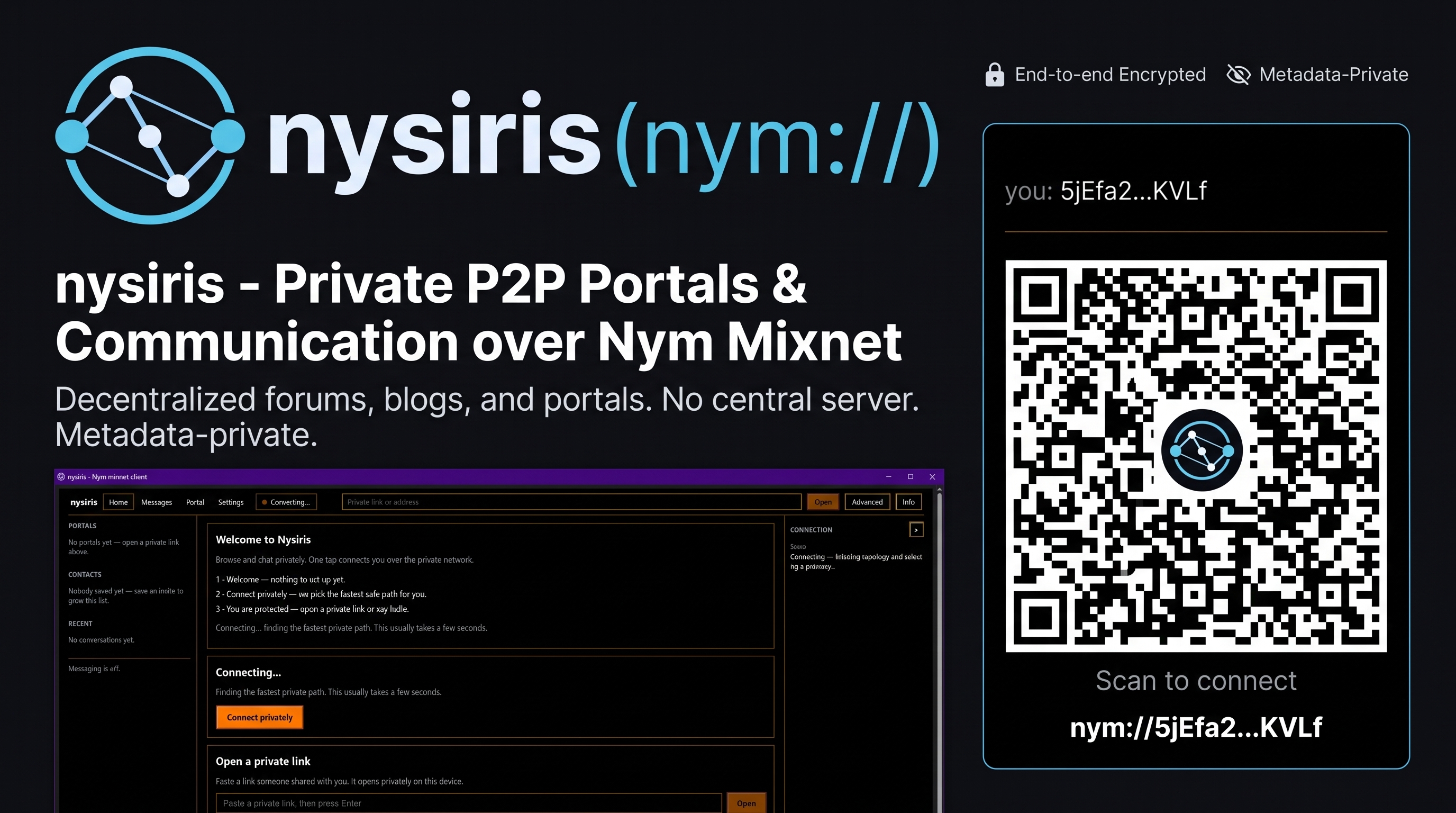
Nysiris is a private browser for the Nym mixnet: a cross-platform client
(web / PWA / Android / desktop) plus the pieces to host your own service on
the mixnet. It gives you a calm, everyday UI — private links, a community
timeline with end-to-end encrypted DMs, and a leak-guarded tunnel — while the
mixnet hides who talks to whom and when from network observers. Formerly
fly-protocol; renamed, nothing else moved.


🌐 nysiris.tribewarez.com · 📖 Documentation wiki
Status: foundations, hosting, browser client, social/DMs, trust
indicators, desktop packaging, and security analysis complete, with the
documented controls enforced in code and tests.
* Reference Rust workspace: 113 tests pass (the soak test is ignored by
default).
* Browser PWA + social logic: 203node --testtests pass (0 skipped
whennode_modulesare present — and the CI gate runs them with
dependencies installed, so the @noble crypto constructions gate too).
* Service hosting: runnable providers +nysirisCLI + hybrid compose +
gateway assets.
* Build system:./build.shfor Rust / web / Android / services / desktop /
Windows / check, plus CI.
* Theservices/*builds depend on Nym's own packages and are not compiled by
the fast./build.sh checkloop.
* The protocol/transport layer is being extracted into
TribeWarez/nysiris-coreand
is vendored as thecore/submodule (pinnedv0.1.3); the five crates are
published on crates.io as0.1.3— see
Build on Nysiris-Core.
Nysiris is split along a deliberate seam, so the protocol can be reused without
carrying the app:
| Nysiris (this repository) | Nysiris-Core | |
|---|---|---|
| Role | the product | the reusable base |
| Scope | browser PWA, Android/desktop shells, service providers, nysiris CLI, reference Sphinx |
chat identity, sealed DMs, encrypted history, rooms, Transport trait, nym-sdk adapter |
| For | private mixnet browsing + self-hosting | your own mixnet app, bot, relay or microservice |
| Build | ./build.sh check · web · services |
cd core && cargo test --workspace --locked |
| Version | VERSION (app releases) |
independent tags; core/ pins v0.1.3 |
Both sides implement the same wire contract (DM envelope, history binding, room
keys), but the dependency only ever points one way: Nysiris-Core must not
depend on this repository.
Two reference consumers ship today: this app and
NCC (Nysiris Chat Commander, PySide6 +
ncc-daemon), a native desktop chat client built on the same crates — a working
example of the “build your own app on the base” path.
If you are not building Nysiris, the base is the useful part. Nysiris-Core is an
Apache-2.0 Rust workspace with no UI, no wallet or token economics, and no
dependency on this repository. It is meant for:
Transport trait to plug inWhat you get (all crates are versioned together, 0.1.3):
nysiris-core — identity, signed DM inner envelope, sealed DM crypto,Transport trait;nysiris-chat-history — encrypted append-only flat-file history (no SQLite);nysiris-chat-core — 1:1 chat engine + capability-key rooms with client-sidenysiris-transport-nym — nym-sdk adapter behind the nym feature (annysiris-testkit — MemoryTransport and fixtures.They are on crates.io — add what you need:
[dependencies]
nysiris-core = "0.1.3"
nysiris-chat-core = "0.1.3"
nysiris-chat-history = "0.1.3"

[dependencies.nysiris-transport-nym]
version = "0.1.3"
features = ["nym"]          # real nym-sdk adapter; heavy first build

[dev-dependencies]
nysiris-testkit = "0.1.3"
Working against unreleased changes? Depend on the tag (or the core/ submodule
vendored here):
nysiris-core = { git = "https://github.com/TribeWarez/nysiris-core", tag = "v0.1.3" }
A minimal engine — send a sealed DM and let the transport deliver it:
use std::sync::Arc;

use nysiris_chat_core::ChatEngine;
use nysiris_chat_history::History;
use nysiris_core::ChatIdentity;
use nysiris_testkit::MemoryTransport;

fn main() -> nysiris_core::Result<()> {
    let identity = ChatIdentity::generate();
    let transport = Arc::new(MemoryTransport::new());
    let history = History::open("state/history", [7u8; 32])?;

    let mut engine = ChatEngine::new(
        identity,
        Vec::new(),          // contacts
        Vec::new(),          // groups
        history,
        transport.clone(),
        "<your nym address>",
    );

    let peer_pubkey_hex = "<peer ed25519 pubkey>";
    let msg = engine.send_dm(peer_pubkey_hex, "hello over the mixnet")?;
    println!("queued {}", msg.msg_id);
    assert_eq!(transport.len(), 1);   // sealed payload ready to send
    Ok(())
}
The example uses nysiris-testkit's in-memory transport so it runs anywhere;
swap in NymTransport::connect(dir, gateway) with features = ["nym"] for real
delivery (address() and recv_timeout() drive the receive loop).
Bring your own transport — the core never opens a socket:
use nysiris_core::error::Result;
use nysiris_core::transport::Transport;

struct MyTransport { /* ... */ }

impl Transport for MyTransport {
    fn name(&self) -> &'static str { "my-transport" }

    fn send(&self, recipient: &str, payload: Vec<u8>) -> Result<()> {
        // deliver `payload` to the Nym address in `recipient`
        Ok(())
    }
}
Honest limits: pre-1.0 API, not independently audited crypto (see the core
SECURITY.md), and no financial features — Nym is the transport, not the
product. Full crate map, wire invariants and migration state:
docs/14-nysiris-core.md.
Nysiris is a private browser and a set of self-hosting services. It is not a
crypto or DeFi product, and it has no financial features:
Nothing in the app asks for a wallet connection, a seed phrase, a token balance,
or a payment. The cryptography here is for private communication — routing,
encryption, and signatures — not for finance.
The Nym mixnet is used strictly as a transport and privacy layer: it hides who
talks to whom and when, it carries fixed-size packets, and SURBs let a service
reply without learning the client's address. That is its whole role here.
The public Nym network has its own token economics — a $NYM token, node
staking, operator rewards, and credentials for clearnet exits. That is Nym's,
not Nysiris's. This repository does not implement $NYM, staking, bonding,
node-operator rewards, or credential purchase flows, and it does not expose or
depend on Nym token economics inside the application:
Running and bonding a Nym node (see services/gateway/ and
docs/04-hosting-services.md) is standard Nym operator work done with Nym's own
tools and wallet, outside the Nysiris application.
| Area | State |
|---|---|
PWA: tunnel, leak guard, Nym-address messaging, fetchNym (+ parallel tagged requests) |
Works (mainnet-verified delivery + SURB reply) |
| Community timeline, threads, E2E DMs (signature-authenticated dead-drop reads), trust dots, petnames, invites, encrypted attachments | Works against a nysiris-social provider you run |
Providers, hybrid bridge, portal store, nysiris CLI |
Works; you operate them (see services/) |
Nysiris-Core as a dependency (crates.io 0.1.3) |
Works: 1:1 DMs + rooms, encrypted history, nym-sdk transport — pre-1.0 API; docs.rs coverage 100% |
Linux .deb, Windows zip |
Works; built by CI on every release tag |
| Android (Capacitor 8, targetSdk 36), MV3 extension | Signed APK/AAB per release (F-Droid / sideload; no proprietary deps); extension is a scaffold |
sphinx-core crypto |
Reference/educational only — never use in production |
Prerequisites: a stable Rust toolchain and Node 24 (the version CI uses for the
browser client and its type-stripping tests).
git clone --recurse-submodules https://github.com/odelyzid/Nysiris.git
cd Nysiris
# already cloned? git submodule update --init --recursive

./build.sh check     # toolchain sanity: fmt + clippy + 113 Rust + 203 web tests
./build.sh web       # build the browser PWA into web/dist
The core/ submodule is the extracted protocol/transport workspace
(Nysiris-Core). It is not a
workspace member, so the fast check loop does not build its nym-sdk
toolchain; build it on demand with cd core && cargo test --workspace --locked.
Run the client from the built bundle (serve web/dist with any static file
server) or with the dev server:
cd web && npm install && npm run dev
Hosting a service on the mixnet (echo / portal / social providers, the hybrid
bridge, and a self-hosted entry gateway) is covered in
docs/04-hosting-services.md and the per-service
READMEs under services/. The nysiris CLI is the
one-command path:
./build.sh services nysiris-cli    # build the CLI
cd services/nysiris-cli
cargo run --release -- host echo                    # run a mixnet service
cargo run --release -- host files --web-root ./public
cargo run --release -- fetch <id.enc@gw> --path /   # test it over the mixnet

:::bash
./build.sh services            # build + test every standalone provider
./build.sh services social     # or just one
The live-network proof — real delivery and a SURB reply against mainnet — is:
./build.sh acceptance
Reach these from the Nysiris omnibox (nym://<id>.<enc>@<gw>/path), or with
the CLI: nysiris fetch <address> --path /. Addresses are shared out of band
on purpose — there is no global directory (docs/05-security.md §5.7).
| Service | Nym address |
|---|---|
| TribeWarez Portal | nym://6BH3ALNQ9L39qsei6QjofNcRRdFydoq82UJ2KE3XTZnq.6vdcFysfmE4yXqsgn3hd2uPPpoE5kvkvot4tYqWWhvKJ@CcYinhLeFU8n6xs78FG6Rz3wvosGTCU2hLB1CZyfkMVe/ |
| Hidden Wiki | nym://9LZZpXYkmwxvuo3JD7udjzuDUCTm9FmDUAnHQb8Hnq2u.8LHeYzMCs5DwVWFxbctuRKL4gqWQvyBnyJASfLYXCdQg@4cdgnckjRBAaaP4ds68YEJPRc78paC4YWMGBDUS8G57C/ |
Listed as-is: no endorsement, no uptime guarantee. Fetched HTML renders in a
sandboxed iframe (no scripts, no forms) — service pages are displayed, never
executed.
Mixing + cover traffic hide who talks to whom and when from network
observers (L1/L3), and services never learn client addresses (SURB replies).
DM dead-drops are destructive and authenticated — only the recipient key
can read them. It does not protect against a compromised endpoint, a
malicious service you choose to use, or timing correlation when cover traffic
is thin. Full analysis: docs/05-security.md.
Prefer a rendered site? These docs are mirrored to the
GitHub Wiki; the project site is
nysiris.tribewarez.com.
docs/01-architecture.md — system overview, twodocs/02-addressing-and-routing.md —alpha, beta, gamma, delta), SURBs, diagrams.docs/04-hosting-services.md — pure mixnetdocs/03-browser-client.md — cross-platformdocs/05-security.md — threat model (L1/L2/L3L/L3G,docs/08-hidden-services.md — hidden-servicenym:// URIs, envelopes, server dispatch, petnames, chunking.docs/13-sdk-cli.md — hosting SDK (nysiris-sdk) andnysiris CLI: host, address, fetch, petname, doctor.docs/09-social.md — nysiris-social: metadata-minimaldocs/07-desktop-linux.md — Linux Mint / Debian.deb, Electron, Tauri, Flatpak) and engine compatibility.docs/14-nysiris-core.md — the extractedcore/ submodule), its boundaries anddocs/06-roadmap.md — phased plan with acceptanceOne entry point for everything:
./build.sh check              # fmt + clippy(-D warnings) + all tests + docs
./build.sh rust --release     # optimized workspace build
./build.sh rust --target aarch64-unknown-linux-gnu
./build.sh wasm               # sphinx-core -> wasm32 (optional)
./build.sh web                # install deps + build the PWA
./build.sh android            # TWA (Bubblewrap) or Capacitor
./build.sh services           # standalone Nym service crates
./build.sh soak               # heavy parser/route soak (release)
./build.sh acceptance         # live-network delivery + SURB reply (needs Nym toolchain)
./build.sh desktop            # Linux .deb (system Chromium); --electron for Electron
./build.sh windows            # Windows zip via MSYS2/MinGW or MSVC (see docs/12-windows.md)
./build.sh all                # rust + check + web
./build.sh clean [--deep]
./build.sh --help
Releases are cut from tags: ./build.sh bump <version>, commit VERSION,
git push origin v<version> — CI builds the .deb + Windows zip and
publishes them with checksums (.github/workflows/release.yml).
./build.sh check runs 113 Rust tests and 203 web unit tests with zero
clippy warnings, validates the JSON manifests, and checks every relative link in
the docs. It runs offline (no npm install). CI runs it on every push/PR.
check; optionalcrates/sphinx-core/fuzz/ (nightly + cargo-fuzz)../build.sh soak runs 5,000 randomised routes/messages in release../build.sh acceptance sends to self and replies over SURBsservices/acceptance/README.md for toolchain setup.| Path | What | Verification |
|---|---|---|
crates/sphinx-core/ |
Reference Sphinx: header/blinding/filler/MAC/Lioness/SURB/address | cargo test -p sphinx-core |
core/ (submodule) |
Extracted protocol/transport workspace: chat identity, sealed DMs, encrypted history, rooms, Transport trait, nym-sdk adapter (pinned v0.1.3, published as 0.1.3) |
cd core && cargo test --workspace --locked |
crates/sphinx-core/src/enforcement.rs |
Route policy, SURB single-use/expiry, reply budget, exit rotation, cover-traffic guardrail | 12 tests |
crates/bridge-guard/ |
Open-proxy guards for the mixnet↔HTTP bridge | 8 tests |
crates/nym-hidden-service/ |
Hidden-service abstraction: URIs, envelopes, dispatch, petnames, chunking | 13 tests |
crates/nysiris-sdk/ |
Hosting SDK: HostConfig, serve harness, traversal-safe StaticFiles, curated re-exports |
11 tests |
crates/portal-data/ |
Portal data model: content-addressed objects, append-only logs, LWW-map | 4 tests |
crates/portal-replication/ |
Sync core: heads, want-lists, verified atomic apply | 12 tests |
crates/portal-reputation/ |
PoW (anti-spam), local reputation scores, provider rate limits | 5 tests |
crates/provider-runtime/ |
Shared hidden-service runtime: transport seam, request loop, PoW + rate guards, route plumbing | 15 tests |
crates/social-format/ |
Byte-exact social wire format: signed envelope framing, attachment binding, size limits, PoW preimages | 15 tests |
crates/sphinx-core/tests/fuzz_parser.rs |
Deterministic mutation fuzzing of all parsers | 6 tests |
crates/sphinx-core/tests/soak.rs |
Randomised route/message soak (release) | ./build.sh soak |
crates/sphinx-core/fuzz/ |
Coverage-guided fuzzing targets (nightly) | cargo +nightly fuzz run parse_packet |
services/echo-provider/ |
Pure-mixnet service provider (nym-sdk 1.21.x messaging) |
Written against documented API; build in place |
services/acceptance/ |
Live-network delivery + SURB reply harness | Passed on mainnet: delivery ≈7.6 s, SURB reply ≈7.1 s |
services/hybrid-bridge/ |
Nym↔HTTP bridge + Caddy + Docker Compose, using bridge-guard |
docker compose config + guard tests |
services/social/ |
nysiris-social: signed-post microblog + E2E DM dead-drop (SQLite, HiddenService); encrypted attachments (content-addressed blobs, chunked + parallel upload); PoW + rate-limit hooks (SOCIAL_POW_BITS, SOCIAL_RATE_PER_DAY); signed dead-drop reads |
17 tests + web/src/adapters/driving/social/ timeline UI |
services/portal-provider/ |
Portal object/log store; PoW + rate-limit hooks (PORTAL_POW_BITS, PORTAL_RATE_PER_DAY) |
5 tests |
services/nysiris-cli/ |
nysiris CLI + nym-sdk transport adapter: host echo/host files, address, fetch, petname, doctor |
9 parser tests + ./build.sh services |
services/gateway/ |
nym-node entry-gateway config, systemd, Nym operator bonding notes (outside the app) |
Templates + operator steps |
web/ |
React PWA: tunnel, mixFetch, Nym-address messaging, fetchNym, portal favourites, nysiris-social timeline, leak guard, runtime enforcement |
203 node --test tests + npm run build |
android/ |
TWA/Capacitor guidance, manifest, network security config | Templates |
desktop/launcher/ |
std-only Linux launcher: loopback static server + Chromium app window | 6 tests |
desktop/debian/ |
.deb packaging (control, postinst, .desktop, icon) |
Built + inspected; ./build.sh desktop |
desktop/electron/ |
Electron alternative (bundled Chromium) | Scaffold |
extension/ |
MV3 desktop scaffold | Load unpacked after bundling |
build.sh + scripts/ |
Rust / web / android / services / check build system | check runs offline |
.github/workflows/ci.yml |
CI | Runs ./build.sh check |
The protocol and transport layer is being extracted from this repository into
TribeWarez/nysiris-core: a
standalone Rust workspace that depends on neither this repository nor any
client. It is vendored here as the core/ submodule, pinned to v0.1.3,
so the extracted code is reviewable from one checkout while the builds stay
decoupled.
| Crate | Responsibility |
|---|---|
nysiris-core |
chat identity, signed DM inner envelope, sealed DM crypto, contacts, message types, Transport trait, sealed files |
nysiris-chat-history |
encrypted append-only flat-file history (no SQLite) |
nysiris-chat-core |
1:1 chat engine plus capability-key rooms with client-side fan-out over the transport trait |
nysiris-transport-nym |
real nym-sdk adapter behind the nym feature; an explicit unavailable stub by default |
nysiris-testkit |
in-memory transport and test fixtures |
Dependency direction (core sits in the middle, and must not depend on either
side):
Nysiris browser PWA ──wire──► Nysiris services ──┐
                                                 ├──► Nysiris-Core
NCC (PySide6 + ncc-daemon) ──────────────────────┘
NCC is the native reference consumer and a
good template for third-party clients. Crate APIs and rustdoc:
docs.rs/nysiris-core,
docs.rs/nysiris-chat-core,
docs.rs/nysiris-chat-history,
docs.rs/nysiris-transport-nym.
Migration status: partially extracted. What moved is the native chat
protocol and Nym transport seam:
ChatIdentity), contacts, message types;from, to, ts, msgId, and body;Transport trait and the nym-sdk adapter, verified on mainnet.What is still in this repository (and why):
| Still here | Why |
|---|---|
crates/sphinx-core |
reference Sphinx implementation + test vectors, never production crypto |
crates/social-format, services/social |
the social wire format and its provider are still service-side; nysiris-social-protocol is planned in core |
crates/nym-hidden-service, crates/provider-runtime, crates/nysiris-sdk |
hosting abstractions consume service crates that have not been extracted yet (nysiris-service is planned) |
web/src/mixnet/, web/src/application/dm.ts |
the browser client is TypeScript and uses @nymproject/*; consuming the Rust chat crates from the PWA needs a wasm build first |
Rules that keep the extraction clean:
nym-sdk toolchain./build.sh check, and the crates publish0.1.3; the API is pre-1.0).Nysiris must not depend onnysiris-chat-core and NCC must not depend on Nysiris; compatibility is aDo not copy core code back. Fix protocol/transport bugs in
nysiris-core, bump the submodule pointer here, and re-run the consumer
build.
:::bash
git submodule update --init --recursive # fetch core/ (pinned tag)
cd core
cargo fmt --check
cargo clippy --workspace --all-targets --locked -- -D warnings
cargo test --workspace --locked
bash scripts/check-nym-pins.sh # from-scratch Nym resolve
cargo check -p nysiris-transport-nym --features nym --locked # heavy; real nym-sdk
To bump the pin: git -C core fetch --tags && git -C core checkout vX.Y.Z,
then commit the updated core pointer (and .gitmodules if the URL changes).
Full details, boundaries, and the remaining extraction checklist:
docs/14-nysiris-core.md.
crates/sphinx-core is a faithful, tested mirror of Nym's sphinx-packet:
SURBs, Nym address parsing (<id>.<enc>@<gw>), path selection
:::bash
./build.sh check
It produces a regular packet of exactly 2413 bytes (348 header + 2065
payload), matching the production network.
⚠️ Not production crypto. Real software must use Nym's audited packages:
@nymproject/mix-tunnel/mixFetch/sdk-full-fat(browser),
nym-sdk/nym-sphinx/sphinx-packet(Rust),nym-client/
nym-socks5-client(standalone). This crate is for education, audit and test
vectors.
./VERSION is the single source of truth for the application version. It drives
the .deb and Electron packages and is kept in sync with web/package.json
and desktop/electron/package.json.
./build.sh bump patch        # 0.1.6 -> 0.1.7
./build.sh bump minor        # 0.1.6 -> 0.2.0
./build.sh bump major        # 0.1.6 -> 1.0.0
./build.sh bump 1.2.3        # set an explicit version

./build.sh desktop                       # -> dist/nysiris_<version>_amd64.deb
./build.sh desktop --electron            # -> Electron .deb + AppImage
./build.sh web && ./build.sh android     # PWA / Android
./build.sh check                         # verify
--app-version X.Y.Z overrides the version for one build without changing
./VERSION.
The Rust crates under
crates/carry their own independent versions
(0.1.0);./VERSIONis the application / package version.
| Component | Where | How |
|---|---|---|
| Rust toolchain | system | rustup update |
| Rust crates | crates/*/Cargo.toml |
edit the version, then cargo update |
| Nym SDK (services) | services/*/Cargo.toml |
cargo search nym-sdk, raise the version, rebuild |
| Nysiris-Core | core/ submodule |
git -C core fetch --tags, check out the new tag, commit the pointer; re-run cd core && cargo test --workspace and the consumer smoke test |
| Browser Nym SDK | web/package.json |
npm view @nymproject/mix-fetch version (and sdk-full-fat), then npm install |
| Electron | desktop/electron/package.json |
npm install electron@latest electron-builder@latest --save-dev |
nym-sdk, nym-bin-common and nym-sphinx are versioned independently on
crates.io (as of this writing nym-sdk 1.21.6 while nym-bin-common is
1.22.0), so raise them individually and re-read the API when you do — the
messaging API has changed between releases.
After any upgrade: ./build.sh check, then ./build.sh acceptance for anything
touching the network path.
build.sh                 one entry point: rust | web | android | services | check | all | clean
scripts/                 modular build commands + doc/JSON validators
.github/workflows/       CI + release + wiki publishing
.github/                 community health: SECURITY, CONTRIBUTING, CODE_OF_CONDUCT, CHANGELOG
.agents/AGENTS.md        guidance for AI coding agents
core/                    nysiris-core submodule: extracted protocol + transport (not a workspace member)
crates/sphinx-core/      reference Sphinx + enforcement controls (workspace)
crates/bridge-guard/     open-proxy guards (workspace)
crates/nym-hidden-service/  hidden-service abstraction: URIs, envelopes, dispatch, petnames (workspace)
crates/nysiris-sdk/      hosting SDK: HostConfig, serve, StaticFiles, re-exports (workspace)
crates/portal-data/      portal objects + append-only logs (workspace)
crates/portal-replication/  sync core: heads, want-lists, verified atomic apply (workspace)
crates/portal-reputation/   PoW + local reputation + rate limits (workspace)
crates/provider-runtime/   shared hidden-service runtime (workspace)
crates/social-format/      byte-exact social wire format (workspace)
docs/                    architecture, addressing/routing, hosting, client, security, desktop, hidden-services, roadmap
services/                echo-provider, hybrid-bridge, portal-provider, social, acceptance, nysiris-cli (standalone) + gateway ops
web/                     React PWA client (TypeScript)
  src/domain/              pure rules/types (no React, no fetch, no storage)
  src/application/        use-cases / orchestration over the ports
  src/adapters/driving/   React components + UI hooks (shell / portal / social / shared)
  src/adapters/driven/    keystore, network, blob + portal-sync I/O
  src/shared/             cross-cutting UI helpers
android/                 Android packaging manifest + guidance
desktop/                 launcher, .deb + Windows packaging, Electron alternative
extension/               MV3 desktop scaffold
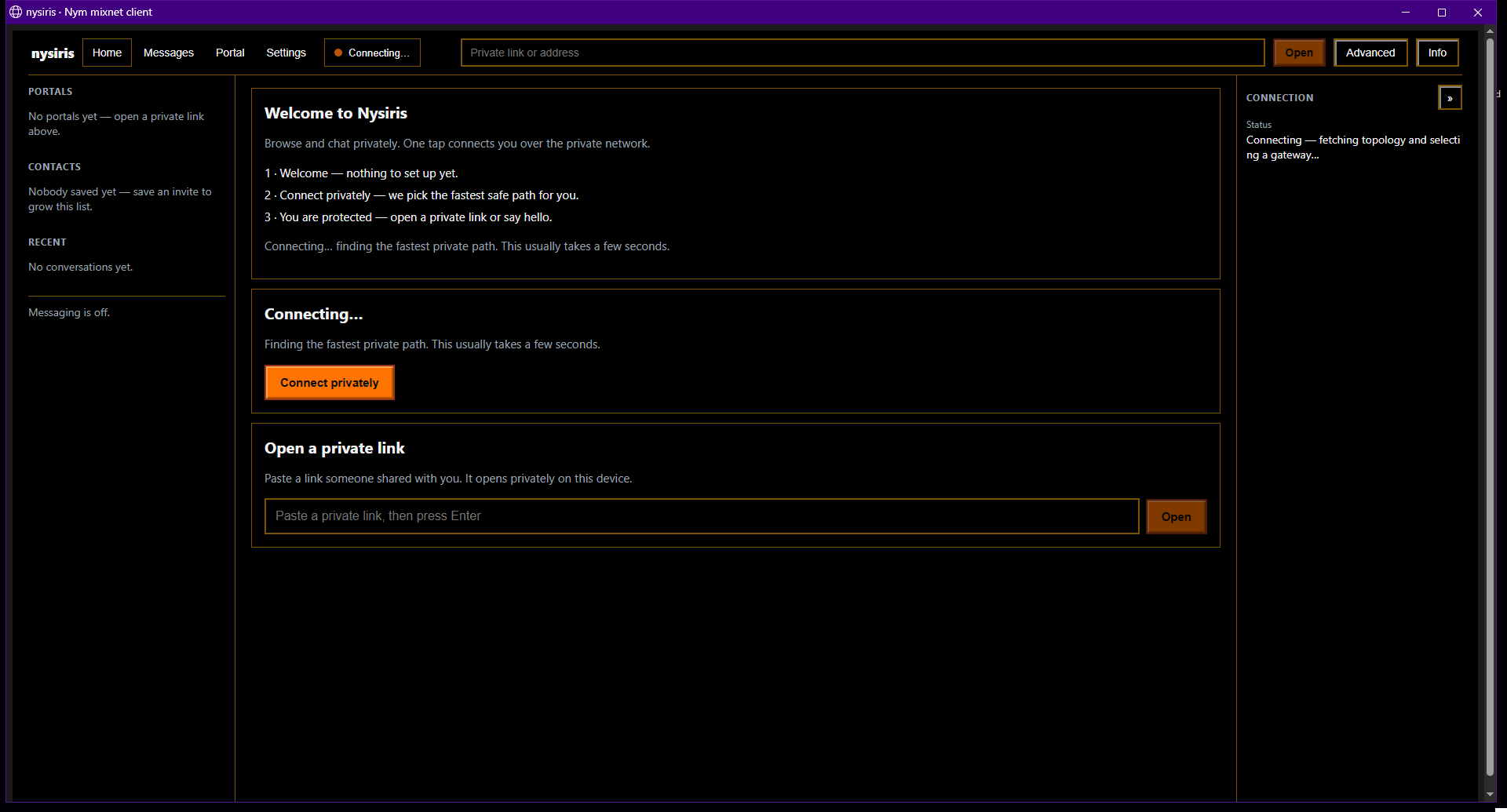
| Home | Messages |
|---|---|
 |
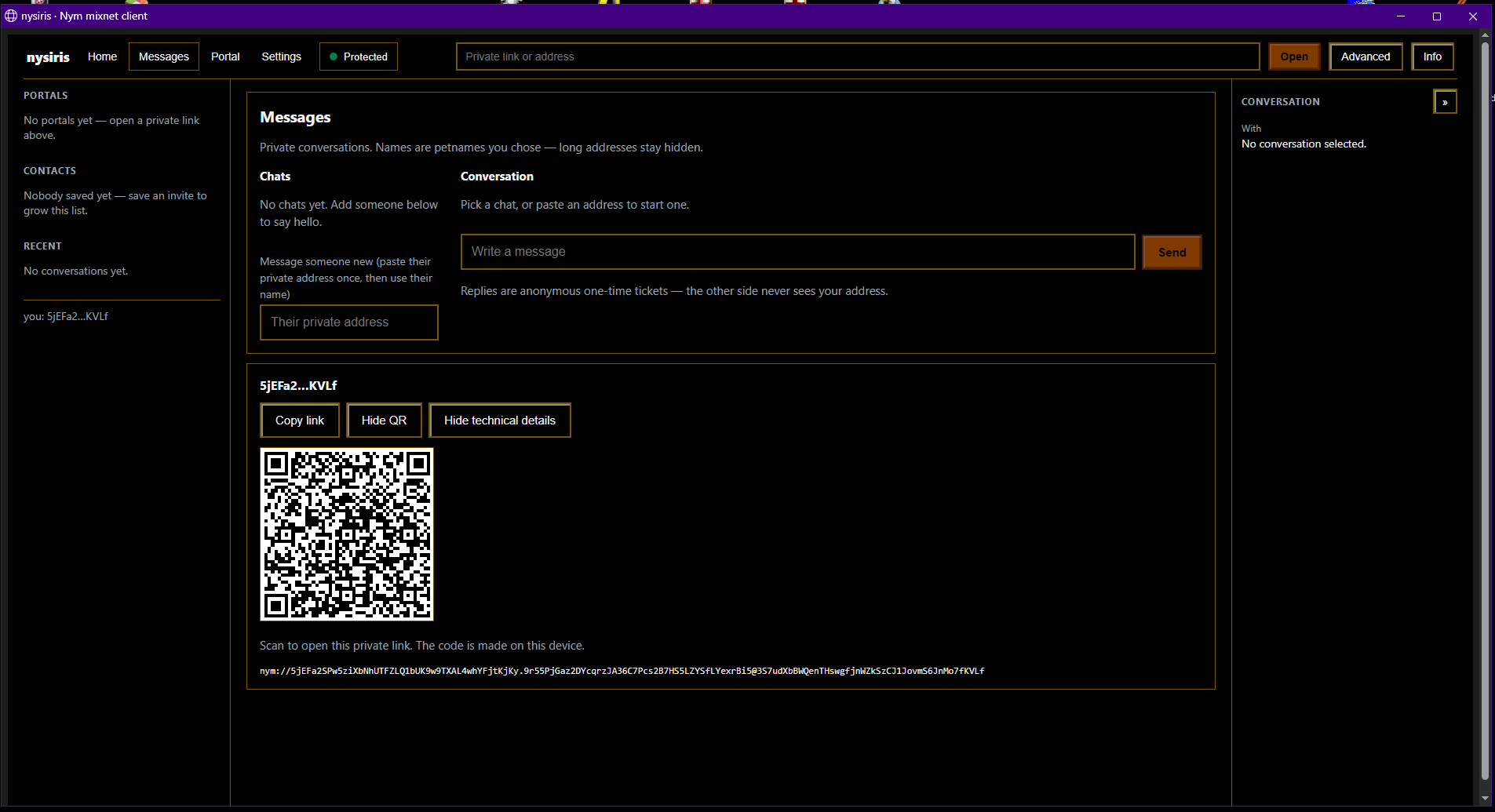 |
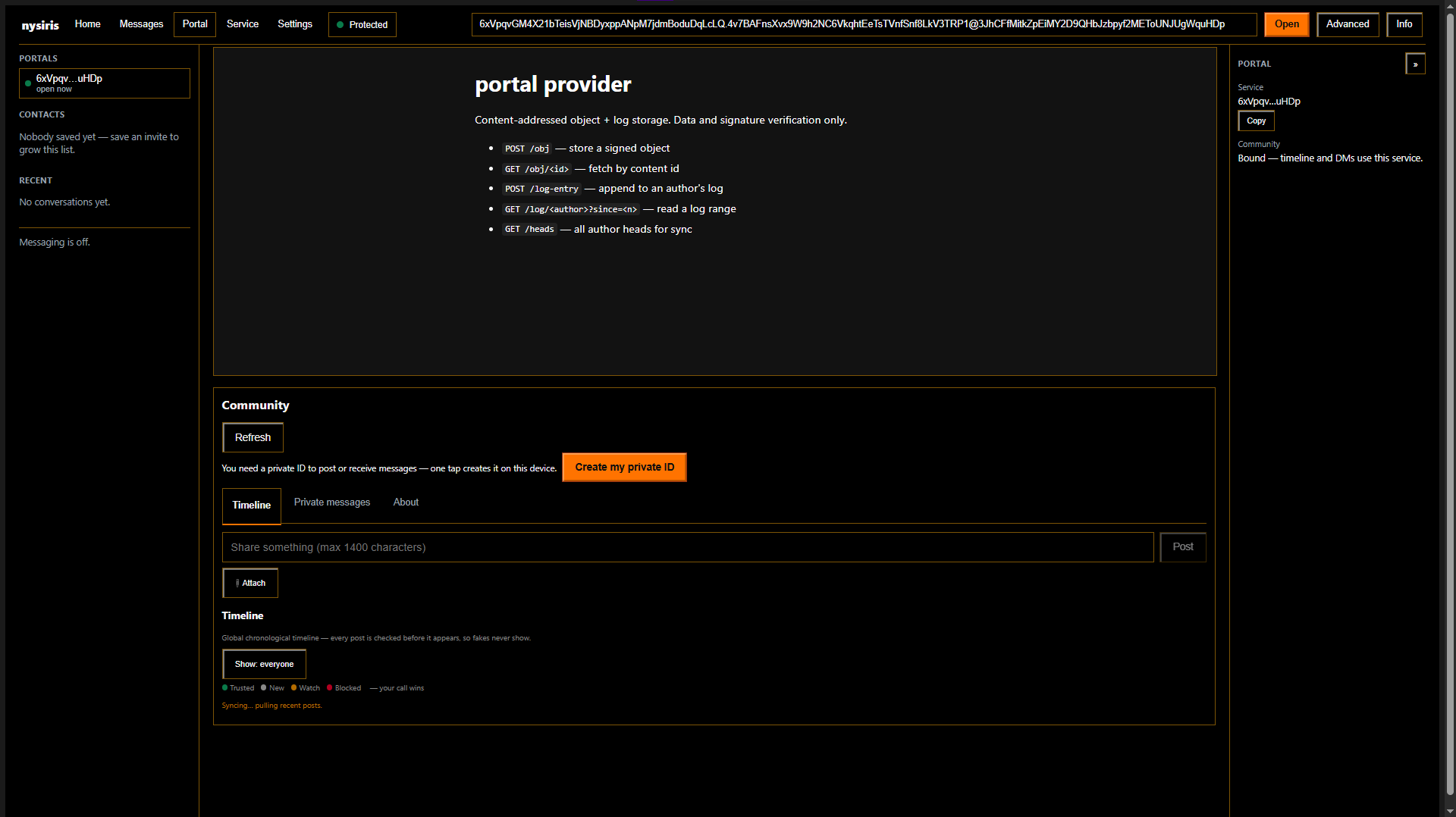
These contain no real addresses, contacts, or messages. Serve web/dist (or a
release package) to click through it yourself — more honest screenshots welcome.
docs/ · GitHub Wiki..github/CONTRIBUTING.md (github.com) (start with .agents/AGENTS.md)..github/SECURITY.md (github.com) — private advisories only..github/CODE_OF_CONDUCT.md (github.com)..github/CHANGELOG.md (github.com).

