
Menu
▾
▴
matplotlib-users
|
From: 不坏阿峰 <onl...@gm...> - 2014-05-16 11:51:27
|
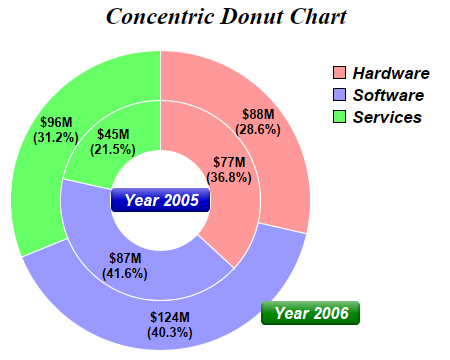
Dear all how to use matplotlib to drew chart like this ? http://www.advsofteng.com/doc/cdpydoc/images/concentric.png |
|
From: Alan G I. <ala...@gm...> - 2014-05-16 12:36:26
|
On 5/16/2014 7:51 AM, 不坏阿峰 wrote: > how to use matplotlib to drew chart like this ? > http://www.advsofteng.com/doc/cdpydoc/images/concentric.png Not an answer to your question: http://www.businessinsider.com/pie-charts-are-the-worst-2013-6 fwiw, Alan Isaac |
|
From: Joe K. <jof...@gm...> - 2014-05-16 14:25:35
Attachments:
figure_1.png
figure_1.png
|
On Fri, May 16, 2014 at 7:36 AM, Alan G Isaac <ala...@gm...> wrote: > On 5/16/2014 7:51 AM, 不坏阿峰 wrote: > > how to use matplotlib to drew chart like this ? > > http://www.advsofteng.com/doc/cdpydoc/images/concentric.png > > > Not an answer to your question: > http://www.businessinsider.com/pie-charts-are-the-worst-2013-6 > > fwiw, > Alan Isaac > Alan is quite right. However, that aside, here's how you'd do it in matplotlib: import matplotlib.pyplot as plt fig, ax = plt.subplots() ax.axis('equal') # Width of the "rings" (percentages if the largest "radius"==1) width = 0.35 # Note the different "radius" values: largest --> outside "donut". kwargs = dict(colors=['#66FF66', '#9999FF', '#FF9999'], startangle=90) inside, _ = ax.pie([45, 87, 77], radius=1-width, **kwargs) outside, _ = ax.pie([96, 124, 88], radius=1, **kwargs) # This is the key. We'll set the "width" for all wedges generated by ax.pie. # (The inside radius for each donut will be "radius" - "width") plt.setp(inside + outside, width=width, edgecolor='white') ax.legend(inside[::-1], ['Hardware', 'Software', 'Services'], frameon=False) plt.show() If you wanted to replicate the example figure more closely, you'll need to get a touch fancier: import matplotlib.pyplot as plt import numpy as np def pie(ax, values, **kwargs): total = sum(values) def formatter(pct): return '${:0.0f}M\n({:0.1f}%)'.format(pct*total/100, pct) wedges, _, labels = ax.pie(values, autopct=formatter, **kwargs) return wedges fig, ax = plt.subplots() ax.axis('equal') width = 0.35 kwargs = dict(colors=['#66FF66', '#9999FF', '#FF9999'], startangle=90) outside = pie(ax, [96, 124, 88], radius=1, pctdistance=1-width/2, **kwargs) inside = pie(ax, [45, 87, 77], radius=1-width, pctdistance=1 - (width/2) / (1-width), **kwargs) plt.setp(inside + outside, width=width, edgecolor='white') ax.legend(inside[::-1], ['Hardware', 'Software', 'Services'], frameon=False) kwargs = dict(size=13, color='white', va='center', fontweight='bold') ax.text(0, 0, 'Year 2005', ha='center', bbox=dict(boxstyle='round', facecolor='blue', edgecolor='none'), **kwargs) ax.annotate('Year 2006', (0, 0), xytext=(np.radians(-45), 1.1), bbox=dict(boxstyle='round', facecolor='green', edgecolor='none'), textcoords='polar', ha='left', **kwargs) plt.show() Hope those examples give you some ideas! Cheers, -Joe |
|
From: 不坏阿峰 <onl...@gm...> - 2014-05-16 15:24:03
Attachments:
figure_1.png
figure_1.png
|
very nice and thanks a lot , you are very nice. and could you give me some guide how to put this in qlabel of pyqt ? or what's widget is better to work with these code 2014-05-16 21:25 GMT+07:00 Joe Kington <jof...@gm...>: > > > > On Fri, May 16, 2014 at 7:36 AM, Alan G Isaac <ala...@gm...>wrote: > >> On 5/16/2014 7:51 AM, 不坏阿峰 wrote: >> > how to use matplotlib to drew chart like this ? >> > http://www.advsofteng.com/doc/cdpydoc/images/concentric.png >> >> >> Not an answer to your question: >> http://www.businessinsider.com/pie-charts-are-the-worst-2013-6 >> >> fwiw, >> Alan Isaac >> > > Alan is quite right. However, that aside, here's how you'd do it in > matplotlib: > > import matplotlib.pyplot as plt > > fig, ax = plt.subplots() > ax.axis('equal') > > # Width of the "rings" (percentages if the largest "radius"==1) > width = 0.35 > > # Note the different "radius" values: largest --> outside "donut". > kwargs = dict(colors=['#66FF66', '#9999FF', '#FF9999'], startangle=90) > inside, _ = ax.pie([45, 87, 77], radius=1-width, **kwargs) > outside, _ = ax.pie([96, 124, 88], radius=1, **kwargs) > > # This is the key. We'll set the "width" for all wedges generated by > ax.pie. > # (The inside radius for each donut will be "radius" - "width") > plt.setp(inside + outside, width=width, edgecolor='white') > > ax.legend(inside[::-1], ['Hardware', 'Software', 'Services'], > frameon=False) > > plt.show() > > > > If you wanted to replicate the example figure more closely, you'll need to > get a touch fancier: > > import matplotlib.pyplot as plt > import numpy as np > > def pie(ax, values, **kwargs): > total = sum(values) > def formatter(pct): > return '${:0.0f}M\n({:0.1f}%)'.format(pct*total/100, pct) > wedges, _, labels = ax.pie(values, autopct=formatter, **kwargs) > return wedges > > fig, ax = plt.subplots() > ax.axis('equal') > > width = 0.35 > kwargs = dict(colors=['#66FF66', '#9999FF', '#FF9999'], startangle=90) > > outside = pie(ax, [96, 124, 88], radius=1, pctdistance=1-width/2, **kwargs) > inside = pie(ax, [45, 87, 77], radius=1-width, > pctdistance=1 - (width/2) / (1-width), **kwargs) > plt.setp(inside + outside, width=width, edgecolor='white') > > ax.legend(inside[::-1], ['Hardware', 'Software', 'Services'], > frameon=False) > > kwargs = dict(size=13, color='white', va='center', fontweight='bold') > ax.text(0, 0, 'Year 2005', ha='center', > bbox=dict(boxstyle='round', facecolor='blue', edgecolor='none'), > **kwargs) > ax.annotate('Year 2006', (0, 0), xytext=(np.radians(-45), 1.1), > bbox=dict(boxstyle='round', facecolor='green', > edgecolor='none'), > textcoords='polar', ha='left', **kwargs) > > plt.show() > > > > Hope those examples give you some ideas! > Cheers, > -Joe > > > > ------------------------------------------------------------------------------ > "Accelerate Dev Cycles with Automated Cross-Browser Testing - For FREE > Instantly run your Selenium tests across 300+ browser/OS combos. > Get unparalleled scalability from the best Selenium testing platform > available > Simple to use. Nothing to install. Get started now for free." > http://p.sf.net/sfu/SauceLabs > _______________________________________________ > Matplotlib-users mailing list > Mat...@li... > https://lists.sourceforge.net/lists/listinfo/matplotlib-users > > |
|
From: 不坏阿峰 <onl...@gm...> - 2014-05-17 04:39:42
Attachments:
figure_1.png
figure_1.png
|
i have try modify Official example use my Qwidget in my Ui. it works. i
am fresher to use matplotlib , maybe my question is stupid . your code is
use pyplot, is the same way to use like below code? i do not how to
change your code to a class, and use with Qwidget.
hope you can give me some guide. thanks a lot
>>>>>>>
from __future__ import unicode_literals
import sys, os, random
from PyQt4 import QtGui, QtCore
from numpy import arange, sin, pi
from matplotlib.backends.backend_qt4agg import FigureCanvasQTAgg as
FigureCanvas
from matplotlib.figure import Figure
from mychart_ui import Ui_Form
class MyMplCanvas(FigureCanvas):
"""Ultimately, this is a QWidget (as well as a FigureCanvasAgg,
etc.)."""
def __init__(self, parent=None, width=5, height=4, dpi=100):
fig = Figure(figsize=(width, height), dpi=dpi)
self.axes = fig.add_subplot(111)
# We want the axes cleared every time plot() is called
self.axes.hold(False)
self.compute_initial_figure()
#
FigureCanvas.__init__(self, fig)
self.setParent(parent)
FigureCanvas.setSizePolicy(self,
QtGui.QSizePolicy.Expanding,
QtGui.QSizePolicy.Expanding)
FigureCanvas.updateGeometry(self)
def compute_initial_figure(self):
pass
class MyStaticMplCanvas(MyMplCanvas):
"""Simple canvas with a sine plot."""
def compute_initial_figure(self):
t = arange(0.0, 3.0, 0.01)
s = sin(2*pi*t)
self.axes.plot(t, s)
## this is my custom Ui design in Qt designer.
class myWidget(QtGui.QWidget, Ui_Form):
def __init__(self,parent=None):
QtGui.QWidget.__init__(self, parent)
self.setupUi(self)
sc = MyStaticMplCanvas(self.matwidget, width=5, height=4, dpi=100)
qApp = QtGui.QApplication(sys.argv)
aw = myWidget()
aw.show()
sys.exit(qApp.exec_())
<<<<<<<<
2014-05-16 22:23 GMT+07:00 不坏阿峰 <onl...@gm...>:
> very nice and thanks a lot , you are very nice.
> and could you give me some guide how to put this in qlabel of pyqt ? or
> what's widget is better to work with these code
>
>
>
>
> 2014-05-16 21:25 GMT+07:00 Joe Kington <jof...@gm...>:
>
>>
>>
>>
>> On Fri, May 16, 2014 at 7:36 AM, Alan G Isaac <ala...@gm...>wrote:
>>
>>> On 5/16/2014 7:51 AM, 不坏阿峰 wrote:
>>> > how to use matplotlib to drew chart like this ?
>>> > http://www.advsofteng.com/doc/cdpydoc/images/concentric.png
>>>
>>>
>>> Not an answer to your question:
>>> http://www.businessinsider.com/pie-charts-are-the-worst-2013-6
>>>
>>> fwiw,
>>> Alan Isaac
>>>
>>
>> Alan is quite right. However, that aside, here's how you'd do it in
>> matplotlib:
>>
>> import matplotlib.pyplot as plt
>>
>> fig, ax = plt.subplots()
>> ax.axis('equal')
>>
>> # Width of the "rings" (percentages if the largest "radius"==1)
>> width = 0.35
>>
>> # Note the different "radius" values: largest --> outside "donut".
>> kwargs = dict(colors=['#66FF66', '#9999FF', '#FF9999'], startangle=90)
>> inside, _ = ax.pie([45, 87, 77], radius=1-width, **kwargs)
>> outside, _ = ax.pie([96, 124, 88], radius=1, **kwargs)
>>
>> # This is the key. We'll set the "width" for all wedges generated by
>> ax.pie.
>> # (The inside radius for each donut will be "radius" - "width")
>> plt.setp(inside + outside, width=width, edgecolor='white')
>>
>> ax.legend(inside[::-1], ['Hardware', 'Software', 'Services'],
>> frameon=False)
>>
>> plt.show()
>>
>>
>>
>> If you wanted to replicate the example figure more closely, you'll need
>> to get a touch fancier:
>>
>> import matplotlib.pyplot as plt
>> import numpy as np
>>
>> def pie(ax, values, **kwargs):
>> total = sum(values)
>> def formatter(pct):
>> return '${:0.0f}M\n({:0.1f}%)'.format(pct*total/100, pct)
>> wedges, _, labels = ax.pie(values, autopct=formatter, **kwargs)
>> return wedges
>>
>> fig, ax = plt.subplots()
>> ax.axis('equal')
>>
>> width = 0.35
>> kwargs = dict(colors=['#66FF66', '#9999FF', '#FF9999'], startangle=90)
>>
>> outside = pie(ax, [96, 124, 88], radius=1, pctdistance=1-width/2,
>> **kwargs)
>> inside = pie(ax, [45, 87, 77], radius=1-width,
>> pctdistance=1 - (width/2) / (1-width), **kwargs)
>> plt.setp(inside + outside, width=width, edgecolor='white')
>>
>> ax.legend(inside[::-1], ['Hardware', 'Software', 'Services'],
>> frameon=False)
>>
>> kwargs = dict(size=13, color='white', va='center', fontweight='bold')
>> ax.text(0, 0, 'Year 2005', ha='center',
>> bbox=dict(boxstyle='round', facecolor='blue', edgecolor='none'),
>> **kwargs)
>> ax.annotate('Year 2006', (0, 0), xytext=(np.radians(-45), 1.1),
>> bbox=dict(boxstyle='round', facecolor='green',
>> edgecolor='none'),
>> textcoords='polar', ha='left', **kwargs)
>>
>> plt.show()
>>
>>
>>
>> Hope those examples give you some ideas!
>> Cheers,
>> -Joe
>>
>>
>>
>> ------------------------------------------------------------------------------
>> "Accelerate Dev Cycles with Automated Cross-Browser Testing - For FREE
>> Instantly run your Selenium tests across 300+ browser/OS combos.
>> Get unparalleled scalability from the best Selenium testing platform
>> available
>> Simple to use. Nothing to install. Get started now for free."
>> http://p.sf.net/sfu/SauceLabs
>> _______________________________________________
>> Matplotlib-users mailing list
>> Mat...@li...
>> https://lists.sourceforge.net/lists/listinfo/matplotlib-users
>>
>>
>
|
|
From: 不坏阿峰 <onl...@gm...> - 2014-05-17 13:55:18
|
Dear all
i try do some modify, it can display the diagram, but not correct. could
you help me correct it ? sorry that i knew a bit about matplotlib. many
thanks!
only display like this.
[image: 内嵌图片 1]
#######################################################
from __future__ import unicode_literals
import matplotlib.pyplot as plt
import numpy as np
import sys, os, random
from PyQt4 import QtGui, QtCore
from numpy import arange, sin, pi
from matplotlib.backends.backend_qt4agg import FigureCanvasQTAgg as
FigureCanvas
from matplotlib.figure import Figure
from mychart_ui import Ui_Form
class MyMplCanvas(FigureCanvas):
"""Ultimately, this is a QWidget (as well as a FigureCanvasAgg,
etc.)."""
def __init__(self, parent=None, width=5, height=4, dpi=100):
#fig = Figure(figsize=(width, height), dpi=dpi)
# self.axes = fig.add_subplot(111)
# We want the axes cleared every time plot() is called
#self.axes.hold(False)
self.fig, self.axes = plt.subplots()
self.compute_initial_figure()
#
FigureCanvas.__init__(self, self.fig)
self.setParent(parent)
# FigureCanvas.setSizePolicy(self,
# QtGui.QSizePolicy.Expanding,
# QtGui.QSizePolicy.Expanding)
# FigureCanvas.updateGeometry(self)
def compute_initial_figure(self):
pass
class MyStaticMplCanvas(MyMplCanvas):
"""Simple canvas with a sine plot."""
def compute_initial_figure(self):
#fig, ax = plt.subplots()
#ax.axis = ('equal')
fig =self.fig
ax = self.axes
ax.axis = ('equal')
width = 0.35
kwargs = dict(colors=['#66FF66', '#9999FF', '#FF9999'],
startangle=90)
outside = pie(ax, [96, 124, 88], radius=1, pctdistance=1-width/2,
**kwargs)
inside = pie(ax, [45, 87, 77], radius=1-width,
pctdistance=1 - (width/2) / (1-width), **kwargs)
plt.setp(inside + outside, width=width, edgecolor='white')
ax.legend(inside[::-1], ['Hardware', 'Software', 'Services'],
frameon=False)
kwargs = dict(size=13, color='white', va='center',
fontweight='bold')
ax.text(0, 0, 'Year 2005', ha='center',
bbox=dict(boxstyle='round', facecolor='blue',
edgecolor='none'),
**kwargs)
ax.annotate('Year 2006', (0, 0), xytext=(np.radians(-45), 1.1),
bbox=dict(boxstyle='round', facecolor='green',
edgecolor='none'),
textcoords='polar', ha='left', **kwargs)
#ax.axes.plot()
def pie(ax, values, **kwargs):
total = sum(values)
def formatter(pct):
return '${:0.0f}M\n({:0.1f}%)'.format(pct*total/100, pct)
wedges, _, labels = ax.pie(values, autopct=formatter, **kwargs)
return wedges
#plt.show()
class myWidget(QtGui.QWidget, Ui_Form):
def __init__(self,parent=None):
QtGui.QWidget.__init__(self, parent)
self.setupUi(self)
sc = MyStaticMplCanvas(self.matwidget, width=5, height=4, dpi=100)
qApp = QtGui.QApplication(sys.argv)
# aw = ApplicationWindow()
# aw.setWindowTitle("%s" % progname)
aw = myWidget()
aw.show()
sys.exit(qApp.exec_())
2014-05-17 11:39 GMT+07:00 不坏阿峰 <onl...@gm...>:
> i have try modify Official example use my Qwidget in my Ui. it works. i
> am fresher to use matplotlib , maybe my question is stupid . your code is
> use pyplot, is the same way to use like below code? i do not how to
> change your code to a class, and use with Qwidget.
>
> hope you can give me some guide. thanks a lot
>
> >>>>>>>
> from __future__ import unicode_literals
> import sys, os, random
> from PyQt4 import QtGui, QtCore
>
> from numpy import arange, sin, pi
> from matplotlib.backends.backend_qt4agg import FigureCanvasQTAgg as
> FigureCanvas
> from matplotlib.figure import Figure
> from mychart_ui import Ui_Form
>
> class MyMplCanvas(FigureCanvas):
> """Ultimately, this is a QWidget (as well as a FigureCanvasAgg,
> etc.)."""
> def __init__(self, parent=None, width=5, height=4, dpi=100):
> fig = Figure(figsize=(width, height), dpi=dpi)
> self.axes = fig.add_subplot(111)
> # We want the axes cleared every time plot() is called
> self.axes.hold(False)
>
> self.compute_initial_figure()
>
> #
> FigureCanvas.__init__(self, fig)
> self.setParent(parent)
>
> FigureCanvas.setSizePolicy(self,
> QtGui.QSizePolicy.Expanding,
> QtGui.QSizePolicy.Expanding)
> FigureCanvas.updateGeometry(self)
>
> def compute_initial_figure(self):
> pass
>
> class MyStaticMplCanvas(MyMplCanvas):
> """Simple canvas with a sine plot."""
> def compute_initial_figure(self):
> t = arange(0.0, 3.0, 0.01)
> s = sin(2*pi*t)
> self.axes.plot(t, s)
>
> ## this is my custom Ui design in Qt designer.
> class myWidget(QtGui.QWidget, Ui_Form):
> def __init__(self,parent=None):
> QtGui.QWidget.__init__(self, parent)
> self.setupUi(self)
> sc = MyStaticMplCanvas(self.matwidget, width=5, height=4, dpi=100)
> qApp = QtGui.QApplication(sys.argv)
>
> aw = myWidget()
> aw.show()
> sys.exit(qApp.exec_())
> <<<<<<<<
>
>
>
>
> 2014-05-16 22:23 GMT+07:00 不坏阿峰 <onl...@gm...>:
>
> very nice and thanks a lot , you are very nice.
>> and could you give me some guide how to put this in qlabel of pyqt ? or
>> what's widget is better to work with these code
>>
>>
>>
>>
>> 2014-05-16 21:25 GMT+07:00 Joe Kington <jof...@gm...>:
>>
>>>
>>>
>>>
>>> On Fri, May 16, 2014 at 7:36 AM, Alan G Isaac <ala...@gm...>wrote:
>>>
>>>> On 5/16/2014 7:51 AM, 不坏阿峰 wrote:
>>>> > how to use matplotlib to drew chart like this ?
>>>> > http://www.advsofteng.com/doc/cdpydoc/images/concentric.png
>>>>
>>>>
>>>> Not an answer to your question:
>>>> http://www.businessinsider.com/pie-charts-are-the-worst-2013-6
>>>>
>>>> fwiw,
>>>> Alan Isaac
>>>>
>>>
>>> Alan is quite right. However, that aside, here's how you'd do it in
>>> matplotlib:
>>>
>>> import matplotlib.pyplot as plt
>>>
>>> fig, ax = plt.subplots()
>>> ax.axis('equal')
>>>
>>> # Width of the "rings" (percentages if the largest "radius"==1)
>>> width = 0.35
>>>
>>> # Note the different "radius" values: largest --> outside "donut".
>>> kwargs = dict(colors=['#66FF66', '#9999FF', '#FF9999'], startangle=90)
>>> inside, _ = ax.pie([45, 87, 77], radius=1-width, **kwargs)
>>> outside, _ = ax.pie([96, 124, 88], radius=1, **kwargs)
>>>
>>> # This is the key. We'll set the "width" for all wedges generated by
>>> ax.pie.
>>> # (The inside radius for each donut will be "radius" - "width")
>>> plt.setp(inside + outside, width=width, edgecolor='white')
>>>
>>> ax.legend(inside[::-1], ['Hardware', 'Software', 'Services'],
>>> frameon=False)
>>>
>>> plt.show()
>>>
>>>
>>>
>>> If you wanted to replicate the example figure more closely, you'll need
>>> to get a touch fancier:
>>>
>>> import matplotlib.pyplot as plt
>>> import numpy as np
>>>
>>> def pie(ax, values, **kwargs):
>>> total = sum(values)
>>> def formatter(pct):
>>> return '${:0.0f}M\n({:0.1f}%)'.format(pct*total/100, pct)
>>> wedges, _, labels = ax.pie(values, autopct=formatter, **kwargs)
>>> return wedges
>>>
>>> fig, ax = plt.subplots()
>>> ax.axis('equal')
>>>
>>> width = 0.35
>>> kwargs = dict(colors=['#66FF66', '#9999FF', '#FF9999'], startangle=90)
>>>
>>> outside = pie(ax, [96, 124, 88], radius=1, pctdistance=1-width/2,
>>> **kwargs)
>>> inside = pie(ax, [45, 87, 77], radius=1-width,
>>> pctdistance=1 - (width/2) / (1-width), **kwargs)
>>> plt.setp(inside + outside, width=width, edgecolor='white')
>>>
>>> ax.legend(inside[::-1], ['Hardware', 'Software', 'Services'],
>>> frameon=False)
>>>
>>> kwargs = dict(size=13, color='white', va='center', fontweight='bold')
>>> ax.text(0, 0, 'Year 2005', ha='center',
>>> bbox=dict(boxstyle='round', facecolor='blue', edgecolor='none'),
>>> **kwargs)
>>> ax.annotate('Year 2006', (0, 0), xytext=(np.radians(-45), 1.1),
>>> bbox=dict(boxstyle='round', facecolor='green',
>>> edgecolor='none'),
>>> textcoords='polar', ha='left', **kwargs)
>>>
>>> plt.show()
>>>
>>>
>>>
>>> Hope those examples give you some ideas!
>>> Cheers,
>>> -Joe
>>>
>>>
>>>
>>> ------------------------------------------------------------------------------
>>> "Accelerate Dev Cycles with Automated Cross-Browser Testing - For FREE
>>> Instantly run your Selenium tests across 300+ browser/OS combos.
>>> Get unparalleled scalability from the best Selenium testing platform
>>> available
>>> Simple to use. Nothing to install. Get started now for free."
>>> http://p.sf.net/sfu/SauceLabs
>>> _______________________________________________
>>> Matplotlib-users mailing list
>>> Mat...@li...
>>> https://lists.sourceforge.net/lists/listinfo/matplotlib-users
>>>
>>>
>>
>
|

