Menu
▾
▴
Re: [FFADO-user] Aureon 7.1 FireWire ffado-mixer panel
|
From: Marco <mar...@ma...> - 2016-05-24 06:49:25
|
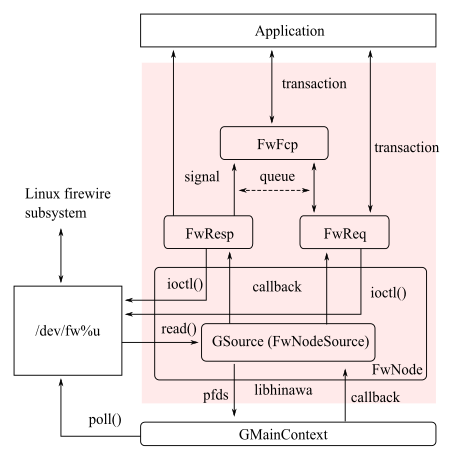
Well... thank you Takashi, really, I have now some work in front of me, ;-) This week I have no time for a windows installation and the mixer test, I will give a try next this week-end probably. Marco Il 23. 05. 16 16:30, Takashi Sakamoto ha scritto: > On May 23 2016 03:00, Marco Brignoli wrote: >> Yes, I have read the mails you have written in the past concerning the >> issues with FunctionBlockEnhancedMixer, etc and I' m aware there is some >> enhancement potential available in the ffadolib... > Yep. But I reccomend not to go to the direction. The most critical issue > is the design of FFADO's D-Bus interface for the function block > (processing). > > The function block requires at least four arguments. In detail, see > clause 10.4 of the specification[1]. On the other hand, FFADO's D-Bus > interface for the function block is for Control::Continuous. This type > of interface can get maximum 2 argumetns[2]. > > According to this restriction (maybe based on misunderstanding of the > specification), FFADO M-Audio driver uses an ugly hack, to multiplex > several arguments into an argument[3]. > > Changing the type of interface causes backward compatibility issue, > therefore I reccomend not to touch it. > >> With "passtrough" I mean a libffado compatible way of communicating >> directly with my device for the mixer function, without incourring in >> the standard problems of having different pieces of software driving one >> device. Maybe this is already ensured by the Firewire protocol stack in >> itself, but as I'm completely new in this field, and I have some >> experiences with other types of bus that are leading me to be really >> prudent, I'm trying to understand which could be a viable approach if I >> would try to use the mixer (assuming it is enabled in the device, I will >> have to revive a Windows box to verify with the official software) > As long as I know, you cannot achieve the 'passthrough'. In FFADO stuff, > 'ffado-dbus-server' handles firewire character devices, and messaging is > processed by libffado library mapped to the server process. Applications > should communicate to the server via D-Bus interface. There's no way to > bypass the server and D-Bus interface, as long as you use ffado-mixer > implementation[4]. > > Several years ago (2013), when realizing this design, I had the same > consideration as you have, because it don't help my work at all. Then, I > concluded to write my own tools[5][6]. The 'hinawa-bebob-parser' is such > a tool and you can see it is quite easy to use and simpler. When you > have some interests, see this ovewview of the library[7]. > > Anyway, 'firewire-request' command of linux-firewire-utils[8] may be a > help of the beginning of your first work. You can check actual effect > when sending bytes of AV/C commands. You can write rough prototype with > this tool. > > [1] AV/C Audio Subunit Specification 1.0 (TA Document 1999008) > http://1394ta.org/wp-content/uploads/2015/07/1998008.pdf > [2] > http://subversion.ffado.org/browser/trunk/libffado/support/dbus/control-interface.xml#L63 > [3] > http://subversion.ffado.org/browser/trunk/libffado/src/bebob/bebob_mixer.cpp#L327 > [4] clause 4.1 of my report. > https://github.com/takaswie/alsa-firewire-report > [5] libhinawa > https://github.com/takaswie/libhinawa > [6] hinawa-utils > https://github.com/takaswie/hinawa-utils > [7] > https://raw.githubusercontent.com/takaswie/libhinawa/master/doc/overview.png > [8] https://github.com/cladisch/linux-firewire-utils > > > Regards > > Takashi Sakamoto |