
Menu
▾
▴
ThermalPowerPlantAppContent
Anonymous

Introduction
Almost all coal, nuclear, geothermal, solar thermal electric, and waste incineration plants, as well as many natural gas power plants are thermal. Natural gas is frequently combusted in gas turbines as well as boilers. The waste heat from a gas turbine can be used to raise steam, in a combined cycle plant that improves overall efficiency. Power plants burning coal, fuel oil, or natural gas are often called fossil-fuel power plants. Some biomass-fueled thermal power plants have appeared also. Non-nuclear thermal power plants, particularly fossil-fueled plants, which do not use co-generation are sometimes referred to as conventional power plants.
Commercial electric utility power stations are usually constructed on a large scale and designed for continuous operation. Electric power plants typically use three-phase electrical generators to produce alternating current (AC) electric power at a frequency of 50 Hz or 60 Hz. Large companies or institutions may have their own power plants to supply heating or electricity to their facilities, especially if steam is created anyway for other purposes. Steam-driven power plants have been used in various large ships, but are now usually used in large naval ships. Shipboard power plants usually directly couple the turbine to the ship’s propellers through gearboxes. Power plants in such ships also provide steam to smaller turbines driving electric generators to supply electricity. Shipboard steam power plants can be either fossil fuel or nuclear. Nuclear marine propulsion is, with few exceptions, used only in naval vessels. There have been perhaps about a dozen turbo-electric ships in which a steam-driven turbine drives an electric generator which powers an electric motor for propulsion. combined heat and power (CH&P) plants, often called co-generation plants, produce both electric power and heat for process heat or space heating. Steam and hot water lose energy when piped over substantial distance, so carrying heat energy by steam or hot water is often only worthwhile within a local area, such as a ship, industrial plant, or district heating of nearby buildings.
The design of a power plant should incorporate two important aspects. Firstly, the selection and placing of necessary power- generating equipment should be such so that a maximum of return will result from a minimum of expenditure over the working life of the plant. Secondly, the operation of the plant should be such so as to provide cheap, reliable and continuous service.
Working Cycle
A steam power station basically works on the Rankine cycle. Steam is produced in the boiler by utilising the heat of coal combustion. The steam is then expanded in the prime mover (i.e., steam turbine) and is condensed in a condenser to be fed into the boiler again. The steam turbine drives the alternator which converts mechanical energy of the turbine into electrical energy. This type of power station is suitable where coal and water are available in abundance and a large amount of electric power is to be generated.
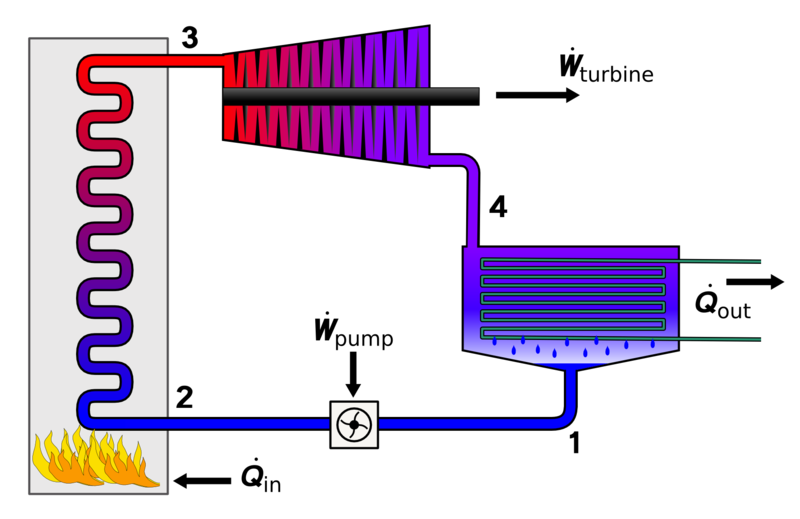
To know more about rankine cycle and John Macquorn Rankine visit Famous Engineers from mobile or from your desktop visit http://fameengineers.blogspot.com/2011/09/william-john-macquorn-rankine.html
Schematic
Although steam power station simply involves the conversion of heat of coal combustion into electrical energy, yet it embraces many arrangements for proper working and efficiency.
A basic schematic arrangment is shown in this topic and has been explained. A more detailed Explaination of mordern thermal plants has been explained later. For sake of simplicity the whole schematic arrangementis divided into following:
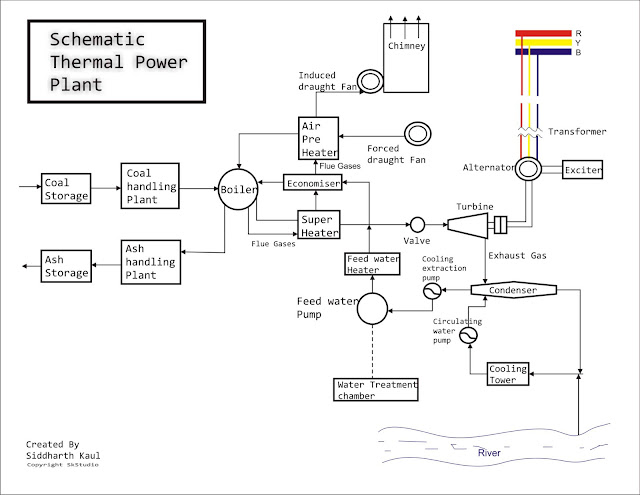
- Coal and ash handling arrangement
- Steam generating plant
- Steam turbine
- Alternator
- Feed water
- Cooling arrangement
Coal and Ash Handling arrangement
The coal is transported to the power station by road or rail and is stored in the coal storage plant. Storage of coal is primarily a matter of protection against coal strikes, failure of transportation system and general coal shortages. From the coal storage plant, coal is delivered to the coal handling plant where it is pulverised (i.e., crushed into small pieces) in order to increase its surface exposure, thus promoting rapid combustion without using large quantity of excess air. The pulverised coal is fed to the boiler by belt conveyors. The coal is burnt in the boiler and the ash produced after the complete combustion of coal is removed to the ash handling plant and then delivered to the ash storage plant for disposal. The removal of the ash from the boiler furnace is necessary for proper burning of coal. It is worthwhile to give a passing reference to the amount of coal burnt and ash produced in a modern thermal power station. A 100 MW station operating at 50% load factor may burn about 20,000 tons of coal per month and ash produced may be to the tune of 10% to 15% of coal fired i.e., 2,000 to 3,000 tons. In fact, in a thermal station, about 50% to 60% of the total operating cost consists of fuel purchasing and its handling.
Steam Generating Plant
The steam generating plant consists of a boiler for the production of steam and other auxiliary equipment for the utilisation of flue gases.
- Boiler. The heat of combustion of coal in the boiler is utilised to convert water into steam at high temperature and pressure. The flue gases from the boiler make their journey through superheater, economiser, air pre-heater and are finally exhausted to atmosphere through the chimney.
- Superheater. The steam produced in the boiler is wet and is passed through a superheater where it is dried and superheated (i.e., steam temperature increased above that of boiling point of water) by the flue gases on their way to chimney. Superheating provides two principal benefits. Firstly, the overall efficiency is increased. Secondly, too much condensation in the last stages of turbine (which would cause blade corrosion) is avoided. The superheated steam from the superheater is fed to steam turbine through the main valve.
- Economiser. An economiser is essentially a feed water heater and derives heat from the flue gases for this purpose. The feed water is fed to the economiser before supplying to the boiler. The economiser extracts a part of heat of flue gases to increase the feed water temperature.
- Air preheater. An air preheater increases the temperature of the air supplied for coal burning by deriving heat from flue gases. Air is drawn from the atmosphere by a forced draught fan and is passed through air preheater before supplying to the boiler furnace. The air preheater extracts heat from flue gases and increases the temperature of air used for coal combustion. The principal benefits of preheating the air are : increased thermal efficiency and increased steam capacity/square metre of boiler surface.
Steam Turbine
The dry and superheated steam from the superheater is fed to the steam turbine through main valve. The heat energy of steam when passing over the blades of turbine is converted into mechanical energy. After giving heat energy to the turbine, the steam is exhausted to the condenser which condenses the exhausted steam by means of cold water circulation.
Alternator
The steam turbine is coupled to an alternator. The alternator converts mechanical energy of turbine into electrical energy. The electrical output from the alternator is delivered to the bus bars through transformer, circuit breakers and isolators.
Feed Water
The condensate from the condenser is used as feed water to the boiler. Some water may be lost in the cycle which is suitably made up from external source. The feed water on its way to the boiler is heated by water heaters and economiser. This helps in raising the overall efficiency of the plant.
Cooling Arrangement
In order to improve the efficiency of the plant, the steam exhausted from the turbine is condensed by means of a condenser. Water is drawn from a natural source of supply such as a river, canal or lake and is circulated through the condenser.
The circulating water takes up the heat of the exhausted steam and itself becomes hot. This hot water coming out from the condenser is discharged at a suitable location down the river. In case the availability of water from the source of supply is not assured throughout the year, cooling towers are used. During the scarcity of water in the river, hot water from the condenser is passed on to the cooling towers where it is cooled. The cold water from the cooling tower is reused in the condenser.
Choice of Site
In order to achieve overall economy, there are few points that should be considered while selecting a site for a steam/thermal power station. These Points have been discussed in this chapter. Keep reading. These points are important both from production and safety poit of view. Machines in these plants work at pretty high temperatures and rotors rotate at fairly large speed any person can be harmed or kill due to recklessness or carelessness of an individual. So proper care needs to be taken to enhance safety and security.
- Supply of fuel. The steam power station should be located near the coal mines so that transportation cost of fuel is minimum. However, if such a plant is to be installed at a place where coal is not available, then care should be taken that adequate facilities exist for the transportation of coal.
- Availability of water. As huge amount of water is required for the condenser, therefore, such a plant should be located at the bank of a river or near a canal to ensure the continuous supply of water.
- Transportation facilities. A modern steam power station often requires the transportation of material and machinery. Therefore, adequate transportation facilities must exist i.e., the plant should be well connected to other parts of the country by rail, road. etc.
- Cost and type of land. The steam power station should be located at a place where land is cheap and further extension, if necessary, is possible. Moreover, the bearing capacity of the ground should be adequate so that heavy equipment could be installed.
- Nearness to load centres. In order to reduce the transmission cost, the plant should be located near the centre of the load. This is particularly important if d.c. supply system is adopted. However, if a.c. supply system is adopted, this factor becomes relatively less important. It is because a.c. power can be transmitted at high voltages with consequent reduced transmission cost. Therefore, it is possible to install the plant away from the load centres, provided other conditions are favourable.
- Distance from populated area. As huge amount of coal is burnt in a steam power station, therefore, smoke and fumes pollute the surrounding area. This necessitates that the plant should be located at a considerable distance from the populated areas.
It is clear that all the above factors cannot be favourable at one place. However, keeping in view the fact that now-a-days the supply system is a.c. and more importance is being given to generation than transmission, a site away from the towns may be selected. In particular, a site by river side where sufficient water is available, no pollution of atmosphere occurs and fuel can be transported economically, may perhaps be an ideal choice.
Note: These are the somewhat non technical details added in the app that has been displayed here. The technical details like type of equipments and effeciecny formulas will not be updated.
Note: This was just a presentation application to score some extra credits and have our project standout. Any errors and issues of the app may or may not be solved over the next eternity.

