Thread: [Embedlets-developer] Re: Design Criteria
Status: Alpha
Brought to you by:
tkosan

|
From: Andrzej J. T. <an...@ch...> - 2003-01-26 21:48:36
|
Ted mentioned (in a private email that he said I could respond to on the list): > Here are a few design criteria that I was working under as > I was exploring the Embedlet event mechanism: > > - Must allow pre-compiled and pre-serialized software > components (Embedlets) to be graphically wired together > using a wiring tool. I'm not against this approach, but am very skeptical of the value of Graphical Programming/Construction tools. Java IDE's attempted to do just that, but real world problems tend to get complex quite quickly, and graphical tools with code generation never managed to step up to the challenges. I have a vision of an Embedlet system where the embedlets themselves can include some reasonably complex logic (kind of like servlets in concept). I don't see these Embedlets being developed using graphical tools, since the logic that can be specified with such soon gets to be more complex and more trouble than just coding it in Java. Developers would create embedlets using normal Java programming tools. This approach would also apply to the creation of device drivers that embedlets could use to control/interface with real hardware devices (such as PLC's for instance). The Outpost container would provide a number of facilities and component services that the embedlets could use. Logging, Management, External Communications, Events and such. The "glue" where you configure the container, all the device drivers and embedlets (components) and standard services, including how they all interact, dependencies and such, would be done using an XML config file, again similar to how servlets and EJB's work these days, and how their respective containers are config'ed (Tomcat, JBoss, WebLogic, etc.) This XML config is likely to not be as simple as James might want, simply because configuration is rather complex as are the applications that users might want to create built on the Outpost framework. Though it should be simpler than something like Tomcat or JBoss's XML config. For more capable processors (eg. PC's with a JVM) the container could dynamically read the config at startup and use dynamic proxies and other techniques to instantiate the "application. On less capable processors, there would have to be a "code generator" that would read the XML config and then generate the "glue" code statically, which would then be compiled into a self- contained Outpost application (container and components) that could actually run on the embedded device. Basically, there would not be a single Outpost Container implementation. Outpost would be a collection of specs, interfaces and utility classes that would have differing implementations for platforms of differing capability. Though the embedlet/device driver code should be common, the deployment of the final application would be different. It's the only way I see to be able to address the wide spectrum of target processor capabilities (uVM to TINI to JStamp to PC, etc.). At some point, if someone wants to build a graphical UI that will generate the XML config files, that's fine and dandy. But I don't think it should drive the architecture of the container, since that will place artificial limits on the container that will likely translate into roadblocks to usage of Outpost in the real world. I thought our goal was to make the integration of outlying devices (some quite intelligent with some serious capability, eg. JStamps) with the back office Enterprise systems (J2EE/.NET/etc) much easier, and especially to get the server-side/corporate Java developers more comfortable with embedded development. Inventing a Graphical programming paradigm will probably not do that (though it might be nice to have of course).....having a good container architecture, some core services, that will allow Java programmers to write embedded code quickly (eg. by using familiar container concepts as already in existance with Servlets et al) will achieve these goals. > - Must run on systems as small as a TINI (and perhaps even > a uvm). Agreed. But PLC's? I think those are too limited in their functionality to include at this stage. (Note: I'm using the classic definition of a PLC here...not that of a generic u-processor. I don't think anything smaller than a high end PIC running uVM should be targetted). > - Can not use dynamic event proxies. Sure! Why not? The Outpost specs should be independent of whether the implementation of an Outpost-compliant container can support dynamic proxies or not (see comments above on how that might work). Some Outpost implementations may well be able to support such advanced features (I see threading, dynamic classloading and the like as similar features, that if available, should be useable, but not mandatory). James's comments on the "standards" that are evolving in the embedded device arena are well taken. But the bulk of these so-called "standards" are in reality just proposals. A true standard is in wide deployment (eg. TCP/IP is a standard, WS-Security is not), and none of these are. I thought our intention was to make Outpost and Embedlets the defacto, open-source standard for such things. The fact that there are similar efforts out there (some of a proprietary nature, something I wish to strongly avoid) just validates our direction and market opportunity. Andrzej Jan Taramina Chaeron Corporation: Enterprise System Solutions http://www.chaeron.com |
|
From: Ted K. <tk...@ya...> - 2003-01-27 07:35:39
|
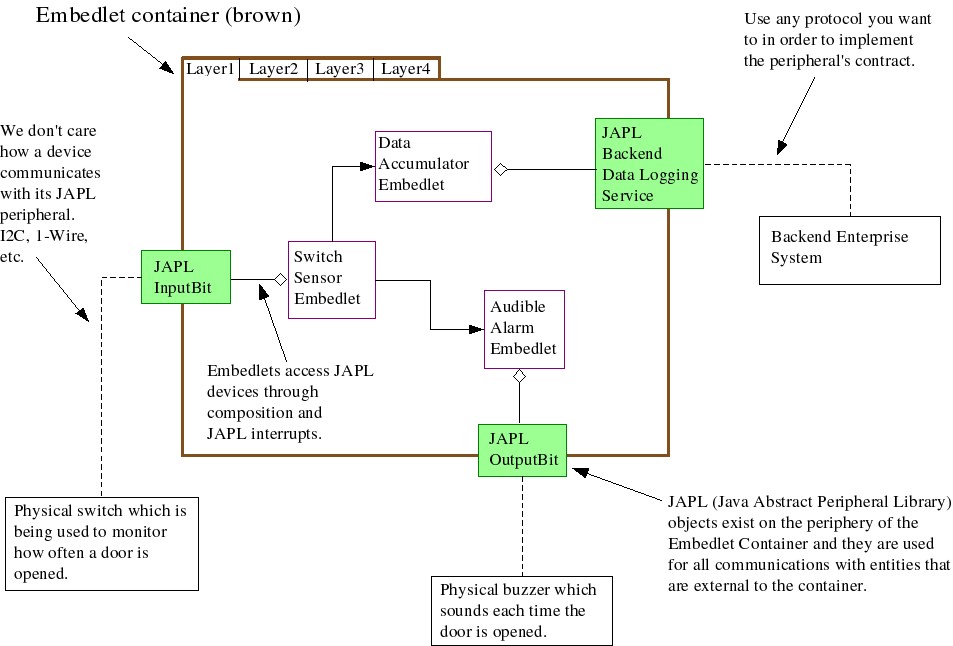
Andrzej, > > Here are a few design criteria that I was working under as > > I was exploring the Embedlet event mechanism: > > > > - Must allow pre-compiled and pre-serialized software > > components (Embedlets) to be graphically wired together > > using a wiring tool. > > I'm not against this approach, but am very skeptical of the value of > Graphical > Programming/Construction tools. Java IDE's attempted to do just that, but > real > world problems tend to get complex quite quickly, and graphical tools with > code generation never managed to step up to the challenges. I have had an interest in Graphical Software Component wiring since attending Mark Davidson's JavaBeans session at JavaOne 2000. Mark Davidson is the JavaBeans technical lead at Sun and over the years I have had the opportunity to ask him what went wrong with the original JavaBeans vision and how this could be fixed. He said that one of the primary problems was that when JavaBeans first came out there was not a good long term persistence mechanism available for it and without this capability a market for JavaBeans components could not be made. JavaStudio and the original BeanBuilder graphically wired together JavaBeans very well but without being able to persist the object graphs that were created the approach was doomed. The early IDE vendors worked around this problem by dynamic code generation but this is a relatively poor and unreliable way to solve the JavaBeans configuration and wiring problem. The new Long Term Persistence API has solved the persistence problem but after the initial failure most people seem to have forgotten that JavaBeans were originally designed as a general purpose software component technology capable of supporting a large software component market for people that wanted to graphically wire applications together. Beyond this, with EJBs and the enterprise market taking off like it did there were little resources or desire to pursue the original JavaBeans vision. Mark and some other people as Sun have been working hard over the years to come through on JavaBeans's early promise and now they have the new BeanBuilder tool that demonstrates that the JavaBeans idea as originally envisioned works. I think that the opportunity to bring this technology to existing IDEs would be a tough sell but the Embedded Java space is just now taking off and I think that this technology could be very successful here. Here is Mark's Software Component Assembly manifesto: http://tkosan.javadevices.org/misc/embeddedjava/manifesto.html The new BeanBuilder tool is open source and I would like to use it as the foundation for the initial proof-of-concept Embedlet Wiring tool. > I have a vision of an Embedlet system where the embedlets themselves can > include some reasonably complex logic (kind of like servlets in concept). I > don't see these Embedlets being developed using graphical tools, since the > logic that can be specified with such soon gets to be more complex and more > trouble than just coding it in Java. We are in complete agreement here. The Embedlets themselves will often be very complex and so they will probably be developed in Java by skilled Java programmers. The graphical wiring capabilities are just for allowing non-programmer application assemblers to assemble applications using standard software components (Embedlets). > The Outpost container would provide a number of facilities and component > services that the embedlets could use. Logging, Management, External > Communications, Events and such. I agree that the container could offer standard services but I think that the services should be pluggable so that if one wanted to put a minimal service Embedlet Container in a uVM it could be easily done. > The "glue" where you configure the container, all the device drivers and > embedlets (components) and standard services, including how they all > interact, dependencies and such, would be done using an XML config file, > again similar to how servlets and EJB's work these days, and how their > respective containers are config'ed (Tomcat, JBoss, WebLogic, etc.) I think that we will need to discuss this point further. I think that if a non-programmer application assembler is developing an Embedlet based application then they should be able to do so by directly wiring the application together using a graphic wiring tool (which is a technique that has been proven to work well by JavaStudio and the various versions of the BeanBuilder). But I agree with you in that I do not want to *force* people to only use a graphic wiring tool to develop Embedlet applications. For experienced Java programmers I think that your deployment via an XML configuration file is an excellent idea that has also been proven to work well in a number of situations. I do not see why we can not provide both mechanisms especially since they seem to be complementary. > This XML config is likely to not be as simple as James might want, simply > because configuration is rather complex as are the applications that users > might want to create built on the Outpost framework. Though it should be > simpler than something like Tomcat or JBoss's XML config. So far the experience I have had with developing a solution to the elevator problem indicates that quite complex applications can be assembled by graphically configuring components and wiring them together. I hope to have my solution available for critiquing within 2 weeks so that we can see if I am missing something critical. > For more capable processors (eg. PC's with a JVM) the container could > dynamically read the config at startup and use dynamic proxies and other > techniques to instantiate the "application. On less capable processors, > there > would have to be a "code generator" that would read the XML config and then > generate the "glue" code statically, which would then be compiled into a > self- > contained Outpost application (container and components) that could actually > run on the embedded device. The route that the wiring tool is taking is to allow the application to be graphically wired together and then the application's complete object graph is saved using the LTP API and then also deserialized into the embedded system. I have already successfully deserialized small applications into a TINI as a proof of concept (it worked well) and I think that this technique will work with the uVM too. >Basically, there would not be a single Outpost > Container implementation. Outpost would be a collection of specs, interfaces > > and utility classes that would have differing implementations for platforms > of > differing capability. Though the embedlet/device driver code should be > common, the deployment of the final application would be different. It's the > > only way I see to be able to address the wide spectrum of target processor > capabilities (uVM to TINI to JStamp to PC, etc.). I think that we should definitively prove that one Embedlet specification is incapable of spanning the full spectrum of target environments before falling back on multiple specifications. I currently think that one specification will be sufficient. > At some point, if someone wants to build a graphical UI that will generate > the > XML config files, that's fine and dandy. But I don't think it should drive > the > architecture of the container, since that will place artificial limits on the > > container that will likely translate into roadblocks to usage of Outpost in > the > real world. > I think that, just like with security, if the graphical wiring capability is not built in from day one that it can not be successfully be tacked on afterwards. In order to accommodate graphic wiring, Embedlets simply need to permit their properties to be configured using setters and getters (achieved mostly through naming conventions) and they need to allow for the registering, unregistering and handling of events. They should suffer no more than normal JavaBeans have by being able to be using in a graphic wiring tool. > I thought our goal was to make the integration of outlying devices (some > quite > intelligent with some serious capability, eg. JStamps) with the back office > Enterprise systems (J2EE/.NET/etc) much easier, and especially to get the > server-side/corporate Java developers more comfortable with embedded > development. With JAPL, Embedlets can handle all possible 'peripherals' from simple devices to the most complex backend system. Again, this is shown in the following simple Embedlet application (notice that it is hooked up to a backend enterprise system): http://embedlets.sourceforge.net/devdocs/diagrams/embedlets_v.05.jpg My primary goal is not to get enterprise developers more comfortable with embedded development. My goal is to allow the semi-technical IT personnel which are present in most companies to be able to graphically wire together Embedded systems and attach them to backend enterprise systems with minimal help from the the enterprise developers. My thought was that the $25/hour IT personnel should not have to bother the $100/hour enterprise personnel more often than was absolutely necessary in order to attach the eventually large number of embedded systems that companies will eventually need to be hooking to their enterprise systems. In my scheme, the enterprise developers are primarily used as a 'back door' method for marketing the Outpost idea to companies. Even though some of them might catch the embedded systems bug, I think that most of them will not have the necessary background for interfacing embedded systems to their company's processes. Without graphic wiring capabilities Embedlets are not usable by my pet target user base. > > - Can not use dynamic event proxies. > > Sure! Why not? The Outpost specs should be independent of whether the > implementation of an Outpost-compliant container can support dynamic > proxies or not (see comments above on how that might work). I spent a significant amount of time digging into the dynamic proxy API and it will only run on JDK 1.3 and up APIs. Numerous classes in the API were enhanced to accommodate dynamic proxies (like the serialization API) and almost no embedded Java system are going to have these capabilities in the near future. The good news is that the main reason that dynamic proxies are needed is because of all the listener types that Java's event mechanism uses like ActionListeners, WindowListeners, etc, etc,. So far my research has indicated that Embedlets will work fine with just *one* event listener: public interface EventReceiver //All Embedlets implement this interface. { receiveEmbedletEvent(EmbedletEvent ee); } Since all Embedlets that need to receive events implement one interface there is no need for dynamic event proxies. Simply have an Embedlet register itself as an event listener for a specific type of EmbedletEvent on any given target Embedlet and thats it. It is so simple that it will easily fit even on uVM. Ted __________________________________________________ Do you Yahoo!? Yahoo! Mail Plus - Powerful. Affordable. Sign up now. http://mailplus.yahoo.com |