Bitloops Language Code
Brought to you by:
sergiopreira

| File | Date | Author | Commit |
|---|---|---|---|
| .github | 2022-10-18 |
 Sergio Pereira
|
[26d811] Update SECURITY.md |
| .vscode | 2022-10-25 |
 Spiros Grigoratos
|
[2f57e5] fixed spaces at (), {} (#30) |
| boilerplate | 2022-10-31 |
 Markos Girgis
|
[e9833f] Create base fastify request (#84) |
| cli | 2022-11-01 |
 Antonis Sardounis
|
[63d9ad] Fix undefined in controller (#97) |
| documentation | 2022-10-15 |
 Vasilis Danias
|
[8ef80b] updated docs config |
| examples | 2022-10-30 |
 Vasilis Danias
|
[2b3bc0] Update setup.bl |
| transpiler | 2022-11-01 |
 ellik95
|
[5f3170] fixed rule path and tests |
| .gitignore | 2022-10-12 |
ellik95
|
[4e9faf] added infra rest fastify package |
| CODE_OF_CONDUCT.md | 2022-10-03 |
Vasilis Danias
|
[79449c] Update CODE_OF_CONDUCT.md |
| CONTRIBUTING.md | 2022-10-24 |
Sergio Pereira
|
[2548e8] Update CONTRIBUTING.md |
| LICENSE | 2022-08-21 |
Vasilis Danias
|
[6e1748] Create LICENSE |
| README.md | 2022-10-27 |
Vasilis Danias
|
[a7a7ca] Update README.md |
| package.json | 2022-10-27 |
 ellik95
|
[1837f1] Refactoring/ts imports (#48) |
| yarn.lock | 2022-10-27 |
ellik95
|
[1837f1] Refactoring/ts imports (#48) |

Quick Start | Discord | GitHub Discussions | GitHub Issues | Contributing
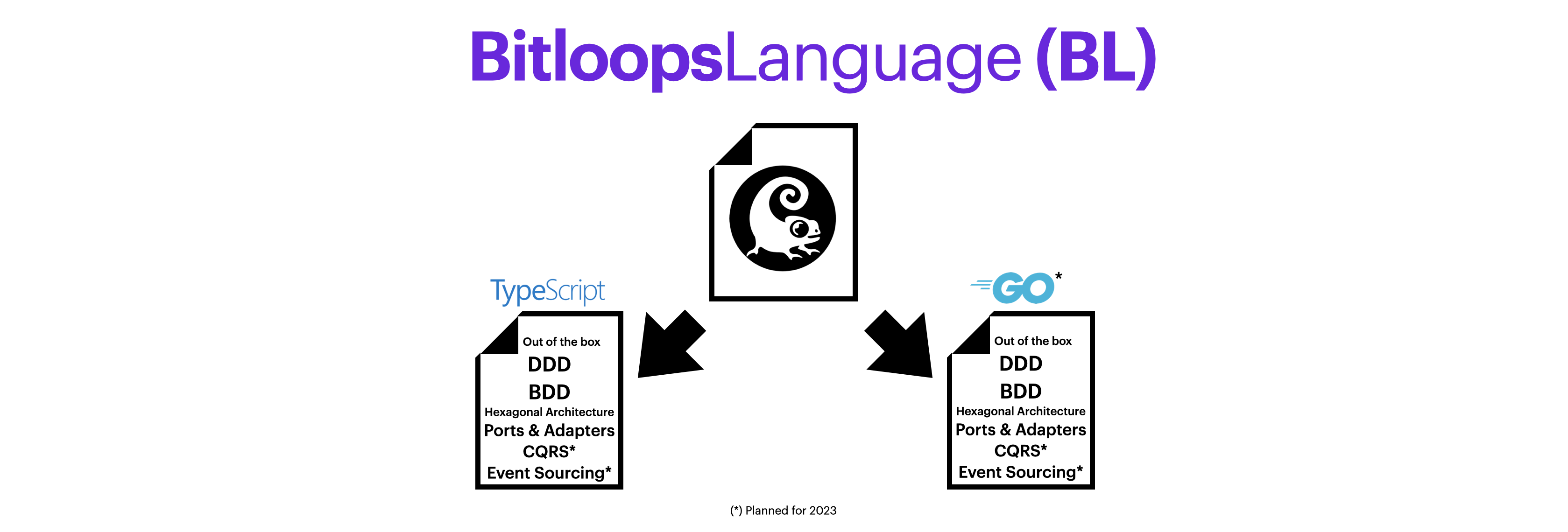
Bitloops Language (BL) is a transpiled, high-productivity, fourth generation, DDD/BDD focused programming language. BL has been built to empower any software developer to build high-quality and well designed software, particularly applications that have complex, and frequently changing, business requirements.
⚠️ Please keep in mind that the Bitloops Language is in its early stages
and under very active development. Expect bugs and limitations.
Full backward compatibility is not guaranteed before reaching v1.0.0.⚠️ We recently started a big migration and refactoring from private repos to this one.
As a result, there are currently a couple important open issues that do not allow for
proper use of the transpiler. We are working on these and expect to have them resolved
before the end of the week. Our focus is to refactor the code and document it so that we
be able to accept your contributions. In the meantime, feel free to check out the examples
folder to see an example Bitloops Language project and its generated TypeScript version
to get a better feel of what the Bitloops Language can do for you.
There are numerous great programming languages out there with massive and growing
codebases and investments. However, the most common problem faced by organizations
that build and maintain systems, with teams of developers working on them, is
good architecture and design; Designing a complex system so that it can last through
time and that will allow developers (existing and new joiners) to work on its codebase
with steady (or hopefully) increasing productivity. Good testing is an additional major
requirement of long lasting products which is also made possible by good architecture
and design. Unfortunately, there aren't enough knowledgeable and experienced senior
engineers around the world to build and maintain great systems for all who need them.
Even when a company is lucky enough to have some, it is unable to hire more
junior engineers than the senior ones can review their work and guide in order to make
sure the system does not degrade over time due to bad design decisions.
The Bitloops Language is the first programming language that aims to address these issues
by making it much easier to adopt important software engineering principles and patterns
such as Domain Driven Design and Behavior Driven Development, without requiring many years
of experience to do so successfully. As a result, the work of senior engineers can be further
leveraged and the contributions of junior engineers significantly boosted.
The Bitloops Language aims to define and retain a simplistic syntax that will be as close to human
language and business logic as possible that will become timeless, helping adopt and use a ubiquitous
language within each module or bounded context. Making the Bitloops Language a transpiled language
was a core decision to achieve exactly this. By allowing oraganisations to write their business logic
in a timeless language that can be transpiled to powerful but also changing target languages without
burdening the users of the Bitloops Language with this task. The Bitloops Language will make sure it
transpiles to optimized code of relevant, up-to-date, and right-for-the-task languages.
The Bitloops Language is currently in early stages. Its transpiler has been created as a proof of concept
and is not meant to cover the full range of developer creative code writing at this stage.
We want to better understand whether we can build a language that meets your needs, and whether we can
gather a critical mass of interest within the DDD community and outside of it.
Currently, we have fleshed out several core aspects of the project and the language:
There are many things we want to add in the future including
[ ] CQRS support
[ ] Event Sourcing support
[ ] Java target language
[ ] gRPC support
[ ] And many more...
If you're interested in contributing, we would love help
If you are already aware of the DDD concepts (Aggregates, Value Objects, Use Cases, Controller, etc.) and know how to code in any modern programming language, it should be really easy to pick up the Bitloops Language.
It is built out of a consistent set of language constructs that should feel familiar and be easy to read and understand.
While Bitloops is an Object Oriented Language, it doesn't have a generic class. Specific Bitloops classes are build-in as follows: ValueObject, Entity, Root Entity, UseCase, RESTController, GraphQLController, GRPCController, DTO, Props, Config, OK, ApplicationError, DomainError, Error etc.
Bitloops Language code like this (11 lines):
// Bitloops Language:
Rule TitleOutOfBoundsRule(title: string) throws DomainErrors.TitleOutOfBoundsError {
  isBrokenIf(title.length > 150 OR title.length < 4);
}

Props TitleProps {
  string title;
}

ValueObject TitleVO {
  constructor(props: TitleProps): (OK(TitleVO), Errors(DomainErrors.TitleOutOfBoundsError)) {
    applyRules(TitleOutOfBoundsRule(props.title));
  }
}
transpiles to this TypeScript code (28 lines):
// TypeScript:
import { Domain, Either, ok, fail } from '@bitloops/bl-boilerplate-core';
import { DomainErrors } from './errors';

export class TitleOutOfBoundsRule implements Domain.IRule {
  constructor(private title: string) {}

  public Error = new DomainErrors.TitleOutOfBounds(this.title);

  public isBrokenIf(): boolean {
    return this.title.length > 150 || this.title.length < 4;
  }
}

export namespace Rules {
    export class TitleOutOfBounds extends TitleOutOfBoundsRule {}
}

interface TitleProps {
  title: string;
}

export class TitleVO extends Domain.ValueObject<TitleProps> {
  get title(): string {
    return this.props.title;
  }

  private constructor(props: TitleProps) {
    super(props);
  }

  public static create(props: TitleProps): Either<TitleVO, DomainErrors.TitleOutOfBounds> {
    const res = Domain.applyRules([new Rules.TitleOutOfBounds(props.title)]);
    if (res) return fail(res);
    return ok(new TitleVO(props));
  }
}
