
We sat down for a Q&A session with Tamas Kadar, CEO and Co-Founder of SEON Fraud Fighters – an Anglo-Hungarian startup that’s been making waves in fintech, ecommerce and every other sector targeted by fraudsters. And in 2022, this is every sector of commercial activity online, especially card-not-present (CNP) payments.
Tamas was eager to highlight those features that make SEON stand out, including digital footprinting, fully customizable platform and architecture, and pay-as-you-go pricing – as well as his vision and SEON’s mission to democratize fraud.

CEO & Co-Founder at SEON
What is SEON and what inspired its creation?
SEON is a fraud prevention provider for ambitious 21st century companies who want to keep their resources and operations safe, as well as their customers, without introducing any friction.
Seven years ago, Bence (Jendruszak) and I were classmates and friends at university. We were also crypto enthusiasts working on a cryptocurrency startup. Of course, we had to make sure we got robust enough and comprehensive enough fraud protection for it. Long story short, we looked at everything on the market and nothing ticked every box for us. And we thought, why not create this fraud prevention solution ourselves?
At the core of our product is our USP: a unique digital footprint data enrichment solution, based on the idea that it is hard and not scalable for fraudsters to mimic a good user’s digital footprint.. We also combine simplicity and full customization for our customers, as well as flexible APIs. Our partners can choose to use industry presets, machine learning suggestions and/or fully custom rules. Everything is fully customizable and transparent/clearbox.
Since 2017, we have become the fraud prevention of choice for over 5,000 merchants, including Revolut, Mollie, Afterpay, and 5000+ other digital leaders and reviewed more than 1 billion transactions. In April 2022, we also completed our Series B, raising $94 million, led by Silicon Valley’s venture capital firm IVP.
What sets SEON apart from other fraud prevention companies?
Because we built the fraud prevention solution we had wanted for ourselves, we tried to cover all bases, and we never stopped improving.
SEON’s email and phone analysis module is a solution that provides you with frictionless insights into who each user truly is starting with the information they voluntarily offer, such as their email address.
It has worldwide coverage and dozens of use cases, from fraud detection and prevention to alternative credit scoring. Another common usage we’ve seen is as a pre-KYC check, to help save costs on expensive AML/KYC processes.
Integration is very important to our customers. SEON can work with your existing stack to add accuracy and reduce friction, using APIs. This allows companies to do automated decisioning based on risk with their users during onboarding, purchases, etc.
We are also completely industry-agnostic. There are benefits to knowing who your customers or visitors really are for almost any online company out there. It’s harder for fraudsters to scale their efforts against companies who use SEON, too, because of our multi-pronged approach.
How can email addresses and phone numbers help fight fraud?
Almost anyone looking to purchase or obtain a product or service online will provide an email or phone number they have – including good and bad users.
Fraudsters are known to sign up for new email accounts to match the identity of the person they are impersonating – or the identity has been made up, if it’s a synthetic or fake ID. So yes, they can fake an email address, or get a burner phone.
But what they can’t do is fully simulate the digital footprint that a legitimate, good user leaves. It is difficult to retroactively create proof that your email address was active five years ago for example, and even if you could, it is not easy to scale.
So we look at things like how many social media accounts an email address is linked to, and whether a phone number has a WhatsApp or Viber account or Skype profile. Another question is, has this address ever been listed in known data branches? That can help us track how old it is.
Hundreds of such data points combine to create a risk score, with even more information that comes from velocity checks, device fingerprinting and the customer’s IP address. The result is a very accurate estimate of the person’s true intentions – and whether they are a good or bad user.
What types of companies can SEON’s fraud fighting solutions help? Sectors?
We are completely industry-agnostic. We work with SMEs of all types, as well as larger companies too, but we are especially loved by startups in highly competitive verticals that are frequently targeted by fraudsters such as fintech, BNPL, iGaming, online lending, ecommerce, and more.
It’s a dangerous landscape out there for startups. Fraudsters will rip you to shreds if you don’t know what you’re doing, and that’s why we’ve made our product so easy and quick to implement. It’s all part of our vision to democratize fraud.
What is implementing SEON like?
Integration can take less than a week, with no interruption to the business. We have absolutely no setup and support fees.
You can find extensive documentation on our website, which is open for the world to see. SEON’s pricing is fully transparent, and you can be up and running in seconds. On top of this, the talented Customer Success Team is entirely made up of fraud managers who are on hand to both answer questions and help you make the best of the solutions. Effectively, they sit between outsourcing and in-house fraud analysts, so you can get the best of both worlds: expert insight in a way that is flexible and not cost-prohibitive. In
in addition to our platform, the team themselves might spot additional patterns in your user sign-ups, for instance.
We have customer-friendly demos that use your own data and discuss your particular needs. For those eager to get started, there’s a free 30-day trial with no commitment.
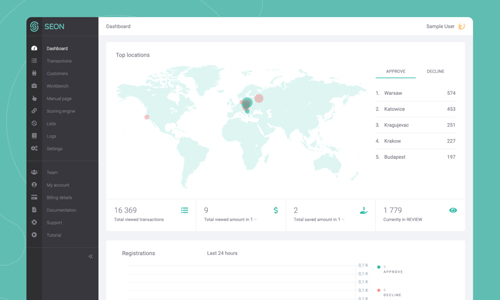
Because of our flexible API modules and the way the platform is built, you do not need to use the SEON dashboard if you don’t want to, either. You can integrate our findings into your platform, thanks to the API calls, and see the results elsewhere. Our product
plays well as part of a fraud prevention stack, although it can also be deployed as a full, end-to-end solution. But our API approach also allows our customers to build better internal products, too.
Tell us more about SEON. What are the key features and capabilities?
We have created a digital footprinting/email and phone lookup solution that is extremely difficult to fool. We have 35+ data sources for these and are always exploring ways to add more. For example, LinkedIn, TripAdvisor and WhatsApp, as well as data breach logger Have I Been Pwned?
The data enrichment API allows these results to scale up, for better insights when working with large datasets. What this means is that both manual reviews and automated decisioning can take place seamlessly no matter the volume of transactions or users.
We employ whitebox machine learning that will suggest new rules based on historical events. This is fully explainable so you can tell exactly why you are seeing a particular risk score. On top of this, we have blackbox ML too, which you can train through the API.
Our API model is the most flexible on the market. It can be used on its own or as part of your risk management stack.
To help customers find links between seemingly different users, we employ powerful velocity and behavioral checks, which are equally flexible and can be adjusted to each company’s requirements, fraud landscape, and risk appetite.
As for getting started with rulesets, there are industry presets tried and tested for specific sectors, there are machine learning suggestions, and there are custom rules to be created by the customer’s anti-fraud team. You don’t need to choose between these; you can use one or all of them at will, or try different approaches with confidence scores and a sandbox mode.
What can someone expect from SEON? Are there knock-on benefits from using it?
Based on our confirmed results, you can expect a reduction in fraud of up to 94%, with 70–80% being typical. Manual review time is slashed by 90%. Fraudsters might keep trying, but not for long. It is too time-consuming and does not scale easily. They will eventually give up, as continuing to target a company that has robust defenses isn’t cost-effective for criminals.
But from there, there are many benefits to businesses looking to grow and increase their revenue:
SEON causes less customer churn due to frictionless footprinting and other analysis. Unlike other fraud prevention strategies, we do not ask your customers for anything but work behind the scenes using data that is either accessible (e.g. IP address or device information) or they have provided themselves (e.g. phone number or email address). This means lower “customer insult” rates and less friction overall.
Another very real benefit is a reduction in chargebacks. Because our merchants are vetting users before they check out and complete their purchase, there is a much lower chance that someone successfully uses a stolen card – so as a merchant you don’t have to suffer the exorbitant costs and frustration of chargebacks.
One last note – for those who have to carry KYC and AML checks, SEON helps slash those costs, since each check is charged individually. By using SEON to screen fraudsters out before they reach KYC, you conduct the expensive KYC checks only on users who appear legitimate. They are more likely to be good users and depending on your legal obligations, you might only want to do KYC on those you aren’t sure about, or at least conduct KYC on fewer users overall, having pre-blocked obvious fraudsters.
But to be honest the use cases for such robust data enrichment are endless. One other benefit comes from using us during user segmentation. You use a customer’s digital footprint data to figure out meaningful demographic information such as the fact that someone who has a Github account is more likely to be an engineer, and thus is a bigger lifetime value customer. So we also carry over into ROI as well as marketing spend, and user acquisition and retention.
What’s next for SEON?
Onwards and upwards! Following our Series B round, which we’re extremely proud about, we are growing and expanding to serve our customers even better.
In addition to our Budapest and London headquarters, we’ve already opened offices in Jakarta and Austin, Texas. There are new locations coming up, including Singapore, and we’re expanding our presence in North America, LATAM and APAC, building partnerships with ecommerce platforms, boosting our products’ functionality, and looking to integrate even more data sources to help customers fight fraud better.
We are also expanding our talented team of fraud fighters, all with the aim of ridding the world of fraud on a global scale.
Related Categories